
In Ayn Rand's Egalitarianism and Inflation she demonstrates the consequences of the introduction of paper money into a thriving agrarian gold-based economy. And she shows how the resulting inflation actually destroys the real-world capital that had previously been accumulated by shifting society's focus from production to consumption.
"Now project what would happen to your community of a hundred hard-working, prosperous, forward-moving people, if one man were allowed to trade on your market, not by means of gold, but by means of paper—i.e., if he paid you, not with a material commodity, not with goods he had actually produced, but merely with a promissory note on his future production. This man takes your goods, but does not use them to support his own production; he does not produce at all—he merely consumes the goods. Then, he pays you higher prices for more goods—again in promissory notes—assuring you that he is your best customer, who expands your market.
"Then, one day, a struggling young farmer, who suffered from a bad flood, wants to buy some grain from you, but your price has risen and you haven’t much grain to spare, so he goes bankrupt. Then, the dairy farmer, to whom he owed money, raises the price of milk to make up for the loss—and the truck farmer, who needs the milk, gives up buying the eggs he had always bought—and the poultry farmer kills some of his chickens, which he can’t afford to feed—and the dairy farmer can’t afford the higher price of alfalfa, so he cancels his order to the blacksmith—and you want to buy the new plow you have been saving for, but the blacksmith has gone bankrupt. Then all of you present the promissory notes to your “best customer,” and you discover that they were promissory notes not on his future production, but on yours—only you have nothing left to produce with. Your land is there, your structures are there, but there is no food to sustain you through the coming winter, and no stock seed to plant.
"Would it make any difference if that community consisted of a thousand farmers? A hundred thousand? A million? The entire globe? No matter how widely you spread the blight, no matter what a variety of products and what an incalculable complexity of deals become involved, this, dear readers, is the cause, the pattern, and the outcome of inflation."
Showing posts with label saving. Show all posts
Showing posts with label saving. Show all posts
Monday, May 17, 2010


Monday, February 22, 2010
My Money Shrugged Turns 1 Year Today!
My Money Shrugged turns 1 today! I want to thank everyone who has checked out the site and who continues to come back daily, weekly or monthly! It is the viewers of this site that keep me posting things I find and other thoughts and ideas I have.
This site started out as a personal finance blog and has evolved into a personal finance/political blog. I know I probably lost a lot of viewers when I started posting about government intervention...*shrugged*. When I started looking at my finances and how I wanted to always be a saver and be prepared for the future, I realized there are so many outside factors that influence my capital. I also dove deeper into economics and now see how government intervention can strongly decrease not only mine but others people's saving through taxation, inflation, and a loss of our freedoms.
I only other thing I would say, is that I would love to start more of a community here, if you feel like commenting on anything I post please do and we can start a conversation so we can learn and exchange ideas and solution that could help with our personal finances and most importantly our freedom.
Thanks again for everyone who reads and send out my links to friends/family/twitter/etc...
“Educate and inform the whole mass of the people... They are the only sure reliance for the preservation of our liberty.” - Thomas Jefferson
This site started out as a personal finance blog and has evolved into a personal finance/political blog. I know I probably lost a lot of viewers when I started posting about government intervention...*shrugged*. When I started looking at my finances and how I wanted to always be a saver and be prepared for the future, I realized there are so many outside factors that influence my capital. I also dove deeper into economics and now see how government intervention can strongly decrease not only mine but others people's saving through taxation, inflation, and a loss of our freedoms.
I only other thing I would say, is that I would love to start more of a community here, if you feel like commenting on anything I post please do and we can start a conversation so we can learn and exchange ideas and solution that could help with our personal finances and most importantly our freedom.
Thanks again for everyone who reads and send out my links to friends/family/twitter/etc...
“Educate and inform the whole mass of the people... They are the only sure reliance for the preservation of our liberty.” - Thomas Jefferson
Friday, January 15, 2010
Thoughts from Chumbawamba
Here is some thoughts from (Chumbawamba) poster over at Zerohedge.com:
In a nutshell (because my education took years, so you can't expect me to give you the important background to my argument in one posting, or even several) this system is f*cked. Our debt-to-GDP ration is well beyond what other empires experienced just before their collapse. Our central bank is monetizing thin air to pay off the financial blackholes created by unregulated/out-of-control over-the-counter derivatives that are valued at well over $600 trillion globally, and our government is planning to borrow every last unit of currency under the moon in order to keep from falling into a fiscal abyss. How the hell does anyone expect this is going to turn out anything but very, very badly?
There are now literally tens of trillions of dollars of liabilities stretching from here on decades into the future. Our debt-based monetary system means these liabilities will only increase in cost and interest as time goes on. From where are the revenues going to come? The pace of productivity and wealth creation in this nation will have to inflate accordingly. How is this going to be accomplished? Do you have any answers? Does anyone?
We took a quantum leap from billions to trillions--a thousand-fold increase--in our economic discourse. It follows then that our GDP will have track this increase to keep up with the new normal. Again, from where are the revenues going to come? Are they going to be conjured up again like magic, so that we go from trillions to quadrillions as the new new normal? Or are you going to be expected to magically increase your productive output 1000 times to make up the difference, along with every other American (including children 1 and older, since we’ll also be needing more manpower for the job, way more than we have even if you include the illegals)?
WHO IS GOING TO PAY FOR ALL OF THIS?
The answer never comes. Oh yeah, this is simple to solve, they say. They'll just "add liquidity" to the market, then "drain it", as if this was just a matter of doing the dishes, and all the complaining and fussing and fearing and loathing and hemming and hawing was all just a matter of no one wanting to pony up to the sink to actually do the deed. But no, that’s just a cheap distraction. So the question remains:
WHO IS GOING TO PAY FOR ALL OF THIS?
I’ll tell you who: Us. As in you. And I. Or at least those of us that are silly enough to file and pay taxes (I don't know about you two, but I do not submit to extortion, otherwise known by the letters I-R-S). And how many people like me do you think there are now? Probably just a relative few. We're the "out there" nutballs. We're the ones that make wild-eye predictions of economic collapse and social chaos to follow. We're the ones who get pooh-poohed. Until the government keeps pulling shit like this. Then we grow in numbers. The disgusted; the disenfranchised; the disaffected. We find each other, learn from each other, and spread the wisdom. We watch as the government creeps upon our God-given freedoms like a depraved predator, one after the other, picking them off until one day we’ll be left naked and defenseless. But we prepare, and in the meantime we keep introducing new people to the mouth of the rabbit hole. And if you’re courageous, and intelligent, you’ll go in. And the deeper down the rabbit hole you go, the more you realize that real money—gold and silver—is the answer.
As more people discover the answer, the dollar takes one step closer to irrelevancy. Once it reaches that point, you have hyperinflation. Once the dollar enters hyperinflation the game is over; or rather, it just begins. But then that's a matter of perspective :)
Will the dollar cross that line of confidence? After all of my study, I sincerely believe it will and am convinced beyond a shadow of doubt about that conviction. I’ve been waiting for someone to come along and explain how I’m wrong about this. Despite my rhetoric, my eyes and mind are open. Convince me. Anyone?
In short: follow Austrian school of economics. I'm not saying they have ALL the answers, but so far it seems they have pretty damn nearly all of them.----------------------------------Ask yourself these questions:
1) What system is collapsing? The one in the US? I.E. the dollar?
1a) If the dollar collapses, what does that mean domestically?
1b) What does it mean internationally?
2) Is the FDIC solvent?
2a) If not, how safe are your bank accounts?
3) Are the firms in which you have your various retirement accounts solvent?
3a) Really? Are you sure? Did you check their balance sheet?
3b) Including all their hidden liabilities?
3c) If not, how safe are you accounts with them?
4) Does America strike you as a financially strong country?
4a) If not, do you think America will remain the world's sole superpower indefinitely under these conditions?
4b) If not, what does that mean for the dollar, the world's reserve currency, and the unit of account upon which all other world currencies (except gold) are based (again, domestically and internationally)?
Mull that over.
But here's a spoiler. The answer to all the above is:
Don't wait until inflation eats away your savings. Every day you wait is like an ounce of silver slipping out of your hands, lost forever.
History is your teacher. All others are substitutes. Including me.
I am Chumbawamba.
This might seem extreme, but he does ask some tough questions...cannot say I disagree and yes I tend to ignore what he says but doesn't mean that I don't feel this way down deep within my beliefs.
Thursday, October 29, 2009
Adding Gold Stocks to Portfolio
So this week I have added some Gold stocks to the mix. Honestly, it is a tad bit scary, as I have only recently been researching gold. Commodities in general kinda freak me out, but this move is something that I truly believe in. I have been following every camp from inflationist, deflationist and stagflationist and even reflationist. I realize that some are calling for a gold bubble and that it could all come crashing down. Personally do see it that way, but I take that into consideration. I think of it more as a hedge against everything. The more I research gold and look into it, I believe I will always keep a percentage of my portfolio as precious metals.
I think that with all the economic turmoil and the continuation of the Fed's total disregard for the dollar that at least I need to protect a certain amount of my cash I have sitting around.
I haven't yet, pulled the trigger on purchasing hard gold or silver. I have been checking it out though.
I like to believe I will always be a saver and that any purchase of hard gold/silver will be the protection of my wealth. As a saver I believe in gold, and the value your wealth has attached to it. Again I would not buy gold as an investment, but more of safe haven of my wealth (which hopefully I will have one day!)
So, I have added a small bit of (AUY, GLD, EGO) and will be showing up in my net worth this coming week.
I think that with all the economic turmoil and the continuation of the Fed's total disregard for the dollar that at least I need to protect a certain amount of my cash I have sitting around.
I haven't yet, pulled the trigger on purchasing hard gold or silver. I have been checking it out though.
I like to believe I will always be a saver and that any purchase of hard gold/silver will be the protection of my wealth. As a saver I believe in gold, and the value your wealth has attached to it. Again I would not buy gold as an investment, but more of safe haven of my wealth (which hopefully I will have one day!)
So, I have added a small bit of (AUY, GLD, EGO) and will be showing up in my net worth this coming week.
Thursday, September 17, 2009
Ron Paul Q&A: Audit the Fed, Then End It
Reprinted from The Wall Street Journal
What would a world without the Fed look like?
You’d go back to the day that if you wanted to borrow money to build a house, somebody would’ve had to save some money. You wouldn’t have zero savings and all the credit in the world. That’s just a total distortion of capitalism. Capital comes from savings. The part you don’t use for everyday living which you have left over, you reinvest and you save or you loan it out. We were living with something absolutely bizarre that had nothing to do with capitalism. We had no savings whatsoever yet there was all the credit in the world.
So without the Fed, there wouldn’t be as much credit.
Yeah, it would be different. If you were selling me a car and the car was worth $10,000 and I didn’t want to pay cash, you could take credit from me. You’ve got to have something to measure it by. What is a dollar? We don’t even know what a dollar is. There’s no definition for a dollar. There’s never been a time in law that said a Federal Reserve note is a dollar. That’s the basic flaw. There’s no definition for money. We’ve built a worldwide economy on a measuring rod that varies every single day. That’s why it was fragile, and that’s why it collapsed. There was no soundness to it. So that’s why you have to have a stable unit of account.
If you live in a primitive society, you’d trade goods. And if you wanted to advance, then you would trade a universal good, which would be a coin. But we’ve become sophisticated and smart and say, ‘Oh, you don’t have to go through that. We’ll just print the money. And we’ll trust the government not to print too much, and distribute it fairly.’ That’s often just a total farce. People are realizing that it is.
Don’t you think the Fed has moderated the business cycle over the past century?
Yes, I think they did smooth things out. The market’s always demanding the correction of the malinvestment and the excessive debt. … Since Bretton Woods broke down, I think every recession has been moderated by the Fed. That’s why the trust kept being built. That’s all a negative. You have to get rid of the mistakes. Moderating it means that we have slowed up the correction. The fact that they have been successful is probably the worst part about it. They’re moderating the rapidity of the crash and the correction by holding the mistakes in place.
What if, years from now, we see that the Fed has returned its balance sheet to its old size and pulled that money back from the system? Would that not be a validation of its approach?
There has only been one time that I know of where they have done that significantly, to withdraw anything of significance. That was after the Civil War. They withdrew greenbacks to a degree, they quit printing greenbacks, and they balanced the budget. I don’t think you can find any other time in our history and probably the history of the world. Because it’s an addiction, and the withdrawal is always much more serious than the continuation. The immediate problem of continuing the inflation is always more acceptable than withdrawal symptoms. Politically there will be continued inflation until it self-destructs.
So you don’t think it’s possible to pull it off?
They might try a little bit. With a weak economy, they’ll say it’s better for the economy to have low interest rates. If we didn’t have a Federal Reserve today, interest rates might be market driven. A lot of people would go bankrupt, but it would benefit the people who save. Capitalism is supposed to benefit the people who save. Even though they’re cheating the people who save, they’re cheating those on fixed income and the elderly, they will not quit inflating. The pain will be too great. They’re smart enough to know? They weren’t smart enough to know when they printed. They created the bubble. All of a sudden they’re going to get smart enough to know when to withdraw this? There’s not one chance in a million that’s going to happen.
But if the Fed were to pull this off and return its balance sheet to a normal size, where would that leave you?
If they were able to shrink their assets by 50%, to a trillion dollars or so … I would say it would challenge a lot of people. But I think the economic laws are in place. It’s only going to be temporary. It’s not going to happen. The only way you could do that is what I’ve been advocating for these last several years. You’ve got to cut spending, you’ve got to balance the budget, you’ve got to stop fighting these wars, you’ve got to bring our troops home, you’ve got to quit expanding the welfare state here at home… But I just don’t think the conditions exist. In theory you could, but if you do that without shrinking the size of the government and shrinking the deficit, it will be disastrous. It won’t work.
How would an audit lead to ending the Fed?
It’s a stepping stone. I think what’s going to lead to the next step is the destruction of the dollar, just like economic events moved further ahead than my legislative process. I wasn’t getting anywhere. But the economic events demanded that we look into it. So even if this bill passes and we have more information and we’re talking about monetary policy reform, I don’t think that’s the way this system is going to be ended. I think it’ll be ended when it’s a total failure and then it’ll have to be replaced by something. It could be replaced with a more authoritarian government, a more socialistic government.
Do you think the Fed will be abolished during your career?
I always thought the day would come… This economy is going to get worse and this dollar is going to get a lot worse. It’ll take care of itself. My real goal is educating people to the nature of money so that when this system fails, that they’ll know what to do and not just say ‘Well, we need a better manager.’
For three decades, Rep. Ron Paul has waged a lonely battle in Congress to abolish the Federal Reserve. But he has more foot soldiers across the nation today, particularly after the financial crisis, who are leading the drive for wider congressional audits of the central bank.
What would a world without the Fed look like?
You’d go back to the day that if you wanted to borrow money to build a house, somebody would’ve had to save some money. You wouldn’t have zero savings and all the credit in the world. That’s just a total distortion of capitalism. Capital comes from savings. The part you don’t use for everyday living which you have left over, you reinvest and you save or you loan it out. We were living with something absolutely bizarre that had nothing to do with capitalism. We had no savings whatsoever yet there was all the credit in the world.
So without the Fed, there wouldn’t be as much credit.
Yeah, it would be different. If you were selling me a car and the car was worth $10,000 and I didn’t want to pay cash, you could take credit from me. You’ve got to have something to measure it by. What is a dollar? We don’t even know what a dollar is. There’s no definition for a dollar. There’s never been a time in law that said a Federal Reserve note is a dollar. That’s the basic flaw. There’s no definition for money. We’ve built a worldwide economy on a measuring rod that varies every single day. That’s why it was fragile, and that’s why it collapsed. There was no soundness to it. So that’s why you have to have a stable unit of account.
If you live in a primitive society, you’d trade goods. And if you wanted to advance, then you would trade a universal good, which would be a coin. But we’ve become sophisticated and smart and say, ‘Oh, you don’t have to go through that. We’ll just print the money. And we’ll trust the government not to print too much, and distribute it fairly.’ That’s often just a total farce. People are realizing that it is.
Don’t you think the Fed has moderated the business cycle over the past century?
Yes, I think they did smooth things out. The market’s always demanding the correction of the malinvestment and the excessive debt. … Since Bretton Woods broke down, I think every recession has been moderated by the Fed. That’s why the trust kept being built. That’s all a negative. You have to get rid of the mistakes. Moderating it means that we have slowed up the correction. The fact that they have been successful is probably the worst part about it. They’re moderating the rapidity of the crash and the correction by holding the mistakes in place.
What if, years from now, we see that the Fed has returned its balance sheet to its old size and pulled that money back from the system? Would that not be a validation of its approach?
There has only been one time that I know of where they have done that significantly, to withdraw anything of significance. That was after the Civil War. They withdrew greenbacks to a degree, they quit printing greenbacks, and they balanced the budget. I don’t think you can find any other time in our history and probably the history of the world. Because it’s an addiction, and the withdrawal is always much more serious than the continuation. The immediate problem of continuing the inflation is always more acceptable than withdrawal symptoms. Politically there will be continued inflation until it self-destructs.
So you don’t think it’s possible to pull it off?
They might try a little bit. With a weak economy, they’ll say it’s better for the economy to have low interest rates. If we didn’t have a Federal Reserve today, interest rates might be market driven. A lot of people would go bankrupt, but it would benefit the people who save. Capitalism is supposed to benefit the people who save. Even though they’re cheating the people who save, they’re cheating those on fixed income and the elderly, they will not quit inflating. The pain will be too great. They’re smart enough to know? They weren’t smart enough to know when they printed. They created the bubble. All of a sudden they’re going to get smart enough to know when to withdraw this? There’s not one chance in a million that’s going to happen.
But if the Fed were to pull this off and return its balance sheet to a normal size, where would that leave you?
If they were able to shrink their assets by 50%, to a trillion dollars or so … I would say it would challenge a lot of people. But I think the economic laws are in place. It’s only going to be temporary. It’s not going to happen. The only way you could do that is what I’ve been advocating for these last several years. You’ve got to cut spending, you’ve got to balance the budget, you’ve got to stop fighting these wars, you’ve got to bring our troops home, you’ve got to quit expanding the welfare state here at home… But I just don’t think the conditions exist. In theory you could, but if you do that without shrinking the size of the government and shrinking the deficit, it will be disastrous. It won’t work.
How would an audit lead to ending the Fed?
It’s a stepping stone. I think what’s going to lead to the next step is the destruction of the dollar, just like economic events moved further ahead than my legislative process. I wasn’t getting anywhere. But the economic events demanded that we look into it. So even if this bill passes and we have more information and we’re talking about monetary policy reform, I don’t think that’s the way this system is going to be ended. I think it’ll be ended when it’s a total failure and then it’ll have to be replaced by something. It could be replaced with a more authoritarian government, a more socialistic government.
Do you think the Fed will be abolished during your career?
I always thought the day would come… This economy is going to get worse and this dollar is going to get a lot worse. It’ll take care of itself. My real goal is educating people to the nature of money so that when this system fails, that they’ll know what to do and not just say ‘Well, we need a better manager.’
Related Reading:
Wednesday, July 22, 2009
Truth Behind Common Financial Advice and Conventional Wisdom
This is a guest post by Mr Credit Card from www.askmrcreditcard.com. Mr Credit Card normally writes about credit card reviews, debt reduction topics and his site obviously has got tons of credit card offers. He has also put together a list of the best credit card offers and deals. Please check out his blog and subscribe to his rss feed. Today, Mr Credit Card is going to branch out and write about a topic that we should all be aware of. So here is his post
If you read the mainstream press and even most personal finance blogs, you will have come across many standard common advice. However, if you look deeper into these "standard advice or thinking", you will find that most of them are just not true or that it comes with a few caveats. Today, I am going to highlight some of these and hope that you will be more discerning whenever the mainstream press gives any so called "standard" advice.
The stock market always goes up in the long run - This common statement derived from studies in the US only from 1926 till present day. Some studies went further back to the late 1800s and came to the same conclusion. Based on this "empirical evidence", the common advice now had been to telling folks that in the 'long run', stocks are always the place to be. Problem with this analysis is that there are many assumptions that have been left out.
The first is that this study holds true only in the US because the United States. In countries like Russia (where communism happened in 1917, or parts of Europe, where there were 2 major world wars in the last century, or even in South America), this conclusion is simply nonsense. Germany went through hyperinflation in the 1930s and a change in currency. One that was pegged to gold and one that was not. South American countries went from being the richest nations in the world to one with massive debt problems in the 80s and 90s. If you were living in those countries, this 1926 US stock market analysis is meaningless when your country faces crisis of epic proportions.
Truth - It only went up in the US (and perhaps Britain) from the time frame of analysis. But bear in mind that the US has not been conquered in war in the last century. We have not had massive currency devaluations or flight of capital. Being careful of the definition of long run. There have been 20 year stretches where the US stock markets did nothing. So if you do not have a 20 year horizon or longer, be very wary about putting the bulk of your money in stocks.
US treasury bills and bonds are the safest investments - The US government treasury bills is considered the safest investments because the US government has never defaulted on its debt obligations. And hence, its historical yield is used in calculations. Because of such assumptions, academics have used the yields on treasury bills as the "risk free asset" (for those of you who study CAPM and stuff). However, there are some flaws to this assumptions.
But in the 1930s, President Roosevelt devalued the dollar by more than half when the dollar was re-pegged to Gold. In the 1970s, President Nixon took the dollar off the gold standard after the French President Charles DeGaulle wanted to exchange the French US Dollar Holdings for gold! In the 1950s, interest rates on long bonds was actually capped at 2+%!
Truth - While in many instances, US T-bills can be considered the safest assets, this only holds true if the US currency does not devalue massively. Today, we are seeing signs that countries like China are wary about their US Dollar reserves and also do not like the fact that the US Dollar's role as the international currency of choice means that we can get away with deficit spending. There is no guarantee that the dollar may lose it's reserve currency stature in future and if that happens, the US dollar will have depreciated a long way. Moral of the story is : have some of your other savings in other currencies and study how to keep your money safe. Perhaps, some gold investments would be good for you?
Reaching a retirement savings of a million dollars is a desirable goal - Another one of those myths that floats around the mainstream media. What puzzles me is that nobody questions this number at all. If a great retirement is your goal, I think that you will find that this number is really not enough. Why?
Using monte carlo analysis, it has determined that by withdrawing up to 4% of your retirement nest egg, you have a more than 85% chance of having your portfolio intact after 30 years. 4% of $1mm is $40,000 a year. And this is after tax money. Firstly, I doubt anyone can live with that amount in a high cost city like New York. Secondly, after factoring in health insurance and all other cost, there ain't much left!
What the mainstream media fail to tell folks is that planning for a career in "retirement" is more important than just "saving for retirement" itself. Afterall, savings can evaporate (ask anyone what happened to their 401ks in 2008). Your countries currency can become worthless (ask any middle Argentinian, or Russian). In the 30s, Germany went through hyperinflation.
Truth - With inflationary monetary policy as part of the western developed world for the last century, the whole million dollar is enough notion will face greater scrutiny sooner or later. You'll probably need much more to enjoy the same standard of living as you have now. If you are earning $100,000 a year today, based on 4% withdrawal rate, you'll need $4 million in retirement savings to have a good chance of achieving the same standard of living.
Small Deficits are OK - The US government has no problems perpetually running budget deficits (saying 3% deficit is OK!). All I can say is that if any household runs a budget deficit for too long, they will sooner or later have to file for bankruptcy. Well, I guess developed countries government like the US can run budget deficits for a longer time than most ordinary households. But sooner or later one's past sins will always catch up.
Deficit spending has a nasty habit of being justified by something that is "really needed". We need to provide health care (very expensive) for the elderly. We need massive military spending. We are fighting two wars. We need to spend money on various programs.
But this mentality spills over to our individual's personal financial life as well. Many folks will say it is "OK" to put the plumbing repairs on the credit card, because we'll "pay it off soon"! Problem is that just like the federal government, most folks do not pay it off. Once in a while, certain "freebies" come along that make our debt load easier. In the case of the federal government, easy monetary policy allows US government debt to be issued at relatively low interest rates. The easy monetary policy has trickled down into the consumer world via promotions like 0% financing for cars, 0% balance transfer credit cards, or even low interest credit cards. For quite long periods of time, these easy monetary policies enabled the federal government and US consumers to "fund deficit spending".
Truth - Debt should be shunned at all cost. What starts as a small amount eventually becomes a habit that becomes very hard to kick.
Global Savings Glut by Emerging Countries Responsible for Global Imbalance - Here's another common economist rant. China, and the Asian emerging economies are savers (which everyone actually acknowledges is good). But they save too much! Because global trade is conducted in US Dollars, countries with trade surpluses have excess savings in US Dollars. And the dollars has to be invested somewhere. The most natural home is US treasuries (ie US government debt). Hence, even if the US is running a persistent budget deficit, savers abroad have no where else but to invest with us. The result for all that is that interest rates and mortgage rates remained low even though our debt picture shouldn't have allowed it.
So what do we tell China and the rest of the world's savers? Don't save so much. Introduce social welfare and health care so people do not have to save so much and they can "spend"! This is one of the worst advice I've heard. We have trouble controlling spending in medicare and social security and now we're telling savers to follow our vices!.
Truth - Truth is the problem is not with savings. It is with the fact that the world conducts it's commerce mainly in US dollars. Savings is the only way to wealth. Savings (just like an emergency fund) gives you cushion. China, for example, could pump billions into their economy without having to borrow from anyone! The good old US however authorized over $700 billion in spending (which by the way they printed!) and they actually have to borrow it from the financial markets. And that is the big problem with having debt. You have to keep issuing IOUs! China's billions was simply gotten by converting their US dollars reserves into Yuan! In personal finance, the same principals apply. When you have debt, whether it is a mortgage, a home equity line of credit or credit card debt, you are constantly on the treadmill trying to find a better card or loan with a better rate. Contrast that to someone who, for example, pays his balance in full. That person can actually use a cash back credit card or gas credit cards to earn cash rebates. Unlike the person having to pay down his or her balance, the person paying in full actually makes money!
Term Life Insurance is Always Better Than Whole Life - Here is another phrase that has been hyped up by the Suze Ormans of the world and literally the whole finance bloggers world. Everyone hates whole life. What nobody has ever properly explained is the cons of term life. So let's look at a few here:
Term life insurance ends after a term - proponents would claim that
1. You can save the money on whole life and invest the difference
2. You do not need insurance after 20 or 30 years cos you have saved enough
3. Term is more cost effective
Problem is nobody tells the downside. The first downside is that
1. The annual premium for term life goes up every year!
2. To maintain the same insurance, you have to keep paying premiums every year. When you are retired and have no "work income" but only portfolio income, monthly payments are a really pain in the B***. For whole life, once you have paid up, it really means you have paid up!
3. By the time you are 50 or 60, you may not have saved enough and your beneficiaries still need money from insurance if you pass away!
4. You have a disabled child and whole life or permanent insurance is the only way to fund it (after all, their needs are permanent!)
Truth - Term life may or may not be more suitable for you. It really depends on your particular situation.
I think I'll stop here. I hope this post makes you think harder and question common teachings and assumptions in the world of personal finance, or anything in fact.
Please leave a comment and tell Mr. Credit Card your thoughts.
If you read the mainstream press and even most personal finance blogs, you will have come across many standard common advice. However, if you look deeper into these "standard advice or thinking", you will find that most of them are just not true or that it comes with a few caveats. Today, I am going to highlight some of these and hope that you will be more discerning whenever the mainstream press gives any so called "standard" advice.
The stock market always goes up in the long run - This common statement derived from studies in the US only from 1926 till present day. Some studies went further back to the late 1800s and came to the same conclusion. Based on this "empirical evidence", the common advice now had been to telling folks that in the 'long run', stocks are always the place to be. Problem with this analysis is that there are many assumptions that have been left out.
The first is that this study holds true only in the US because the United States. In countries like Russia (where communism happened in 1917, or parts of Europe, where there were 2 major world wars in the last century, or even in South America), this conclusion is simply nonsense. Germany went through hyperinflation in the 1930s and a change in currency. One that was pegged to gold and one that was not. South American countries went from being the richest nations in the world to one with massive debt problems in the 80s and 90s. If you were living in those countries, this 1926 US stock market analysis is meaningless when your country faces crisis of epic proportions.
Truth - It only went up in the US (and perhaps Britain) from the time frame of analysis. But bear in mind that the US has not been conquered in war in the last century. We have not had massive currency devaluations or flight of capital. Being careful of the definition of long run. There have been 20 year stretches where the US stock markets did nothing. So if you do not have a 20 year horizon or longer, be very wary about putting the bulk of your money in stocks.
US treasury bills and bonds are the safest investments - The US government treasury bills is considered the safest investments because the US government has never defaulted on its debt obligations. And hence, its historical yield is used in calculations. Because of such assumptions, academics have used the yields on treasury bills as the "risk free asset" (for those of you who study CAPM and stuff). However, there are some flaws to this assumptions.
But in the 1930s, President Roosevelt devalued the dollar by more than half when the dollar was re-pegged to Gold. In the 1970s, President Nixon took the dollar off the gold standard after the French President Charles DeGaulle wanted to exchange the French US Dollar Holdings for gold! In the 1950s, interest rates on long bonds was actually capped at 2+%!
Truth - While in many instances, US T-bills can be considered the safest assets, this only holds true if the US currency does not devalue massively. Today, we are seeing signs that countries like China are wary about their US Dollar reserves and also do not like the fact that the US Dollar's role as the international currency of choice means that we can get away with deficit spending. There is no guarantee that the dollar may lose it's reserve currency stature in future and if that happens, the US dollar will have depreciated a long way. Moral of the story is : have some of your other savings in other currencies and study how to keep your money safe. Perhaps, some gold investments would be good for you?
Reaching a retirement savings of a million dollars is a desirable goal - Another one of those myths that floats around the mainstream media. What puzzles me is that nobody questions this number at all. If a great retirement is your goal, I think that you will find that this number is really not enough. Why?
Using monte carlo analysis, it has determined that by withdrawing up to 4% of your retirement nest egg, you have a more than 85% chance of having your portfolio intact after 30 years. 4% of $1mm is $40,000 a year. And this is after tax money. Firstly, I doubt anyone can live with that amount in a high cost city like New York. Secondly, after factoring in health insurance and all other cost, there ain't much left!
What the mainstream media fail to tell folks is that planning for a career in "retirement" is more important than just "saving for retirement" itself. Afterall, savings can evaporate (ask anyone what happened to their 401ks in 2008). Your countries currency can become worthless (ask any middle Argentinian, or Russian). In the 30s, Germany went through hyperinflation.
Truth - With inflationary monetary policy as part of the western developed world for the last century, the whole million dollar is enough notion will face greater scrutiny sooner or later. You'll probably need much more to enjoy the same standard of living as you have now. If you are earning $100,000 a year today, based on 4% withdrawal rate, you'll need $4 million in retirement savings to have a good chance of achieving the same standard of living.
Small Deficits are OK - The US government has no problems perpetually running budget deficits (saying 3% deficit is OK!). All I can say is that if any household runs a budget deficit for too long, they will sooner or later have to file for bankruptcy. Well, I guess developed countries government like the US can run budget deficits for a longer time than most ordinary households. But sooner or later one's past sins will always catch up.
Deficit spending has a nasty habit of being justified by something that is "really needed". We need to provide health care (very expensive) for the elderly. We need massive military spending. We are fighting two wars. We need to spend money on various programs.
But this mentality spills over to our individual's personal financial life as well. Many folks will say it is "OK" to put the plumbing repairs on the credit card, because we'll "pay it off soon"! Problem is that just like the federal government, most folks do not pay it off. Once in a while, certain "freebies" come along that make our debt load easier. In the case of the federal government, easy monetary policy allows US government debt to be issued at relatively low interest rates. The easy monetary policy has trickled down into the consumer world via promotions like 0% financing for cars, 0% balance transfer credit cards, or even low interest credit cards. For quite long periods of time, these easy monetary policies enabled the federal government and US consumers to "fund deficit spending".
Truth - Debt should be shunned at all cost. What starts as a small amount eventually becomes a habit that becomes very hard to kick.
Global Savings Glut by Emerging Countries Responsible for Global Imbalance - Here's another common economist rant. China, and the Asian emerging economies are savers (which everyone actually acknowledges is good). But they save too much! Because global trade is conducted in US Dollars, countries with trade surpluses have excess savings in US Dollars. And the dollars has to be invested somewhere. The most natural home is US treasuries (ie US government debt). Hence, even if the US is running a persistent budget deficit, savers abroad have no where else but to invest with us. The result for all that is that interest rates and mortgage rates remained low even though our debt picture shouldn't have allowed it.
So what do we tell China and the rest of the world's savers? Don't save so much. Introduce social welfare and health care so people do not have to save so much and they can "spend"! This is one of the worst advice I've heard. We have trouble controlling spending in medicare and social security and now we're telling savers to follow our vices!.
Truth - Truth is the problem is not with savings. It is with the fact that the world conducts it's commerce mainly in US dollars. Savings is the only way to wealth. Savings (just like an emergency fund) gives you cushion. China, for example, could pump billions into their economy without having to borrow from anyone! The good old US however authorized over $700 billion in spending (which by the way they printed!) and they actually have to borrow it from the financial markets. And that is the big problem with having debt. You have to keep issuing IOUs! China's billions was simply gotten by converting their US dollars reserves into Yuan! In personal finance, the same principals apply. When you have debt, whether it is a mortgage, a home equity line of credit or credit card debt, you are constantly on the treadmill trying to find a better card or loan with a better rate. Contrast that to someone who, for example, pays his balance in full. That person can actually use a cash back credit card or gas credit cards to earn cash rebates. Unlike the person having to pay down his or her balance, the person paying in full actually makes money!
Term Life Insurance is Always Better Than Whole Life - Here is another phrase that has been hyped up by the Suze Ormans of the world and literally the whole finance bloggers world. Everyone hates whole life. What nobody has ever properly explained is the cons of term life. So let's look at a few here:
Term life insurance ends after a term - proponents would claim that
1. You can save the money on whole life and invest the difference
2. You do not need insurance after 20 or 30 years cos you have saved enough
3. Term is more cost effective
Problem is nobody tells the downside. The first downside is that
1. The annual premium for term life goes up every year!
2. To maintain the same insurance, you have to keep paying premiums every year. When you are retired and have no "work income" but only portfolio income, monthly payments are a really pain in the B***. For whole life, once you have paid up, it really means you have paid up!
3. By the time you are 50 or 60, you may not have saved enough and your beneficiaries still need money from insurance if you pass away!
4. You have a disabled child and whole life or permanent insurance is the only way to fund it (after all, their needs are permanent!)
Truth - Term life may or may not be more suitable for you. It really depends on your particular situation.
I think I'll stop here. I hope this post makes you think harder and question common teachings and assumptions in the world of personal finance, or anything in fact.
Please leave a comment and tell Mr. Credit Card your thoughts.
Tuesday, July 21, 2009

Wednesday, July 15, 2009
Alternative Ways To Save a Few Extra Dollars
 I have two small ways I save money which take absolutely no energy and doesn't effect my lifestyle the least bit. The concept of saving money is very easy, it is the actual implementation of actually saving it, which is hard. Once I sat down and figured out where I could save, I found more and more places. The great thing about finding small places to save money here and there is that it can help you in other areas of your budget. For example, you might not want to cut out eating out or a similar costly lifestyle, so the more you save elsewhere, the more your budget frees up for the stuff you really want to spend your money on.
One of the ways I save, which is not mind blowing, is that I save my loose change. I have a box by my door and I throw my loose change in it. Once it is full, I will take that money and usually find a goldstar machine(which I get charged 8%) and cash it in. I might take the $40-$80 I have saved up over 6-12 months and either reinvest it by putting in a high yields savings account or if I have a big purchase coming up, I will use instead of breaking into any of my other savings.
Another way I save money is rounding up every dollar when balancing my checkbook/budget. Even if it is $1.01 I round it to $2.00 and so forth with every dollar I spend. This surprising adds up really fast. I have been doing this for about 3 years and I have accumulated close to $400.00. I balance my checkbook every week and base all my numbers off the numbers in my check book, not what my bank is telling me online.
This also acts as a buffer for any overdraft and such. I keep an extra $1000.00 in my checking and use the 1k as my profit line or $0.00. I have a budget and I know where all my money is going so I don't really need it, but it is better than having to worry about getting overdrafted or if anything where to come up. I also take the remaning amount of money sitting in my account that is left over from the month before that is over the $1k and transfer it into my high yield savings account. That way I maximize the money that can be working for me.
I have more small tricks I use, but they are not a easy as these. Like I mentioned earlier, this has never effected me or my lifestyle, it is just a way of life. Again it all starts with the small stuff, I believe this can save you somewhere between $100-$500 a year if you implement these two. If you can find 5 things you can save this much on, you will start to accumulate wealth, which can be saved or reinvested.
Have any saving tips that do not effect your lifestyle? Leave a comment and let me know!
Tuesday, July 14, 2009
How an Economy Grows and Why It Doesn't
Here is a link to the PDF version it is a book by Irwin Schiff. As the title suggest, the book breaks down the simple basics of "How an Economy Grows and Why It Doesn't". Peter Schiff mentioned on his Vlog that the book is going to be reprinted.
The banks could have used this book, along with the majority of American. Read it, study it, pass it along so we can learn from our mistakes. Have a great day!
Friday, July 10, 2009
The 4 different Scenarios: Keeping Your Money Safe
 I had a conversation with a friend earlier this week about how he see the market playing out over the next 5 years. My friend works in the financial sector and has worked for companies such as GE Financial along with having a finance degree. Some of our discussion was around all the different scenarios that we might see and how bad is everything.
 I also mentioned earlier in a post this week that I was thinking about purchasing some shares in some ETF's that short the financials. After talking with him about this, these are some of his main points and what he is doing with his money*.
Not to say there isn't a chance for deflation or shorting bank stocks or real estate is a bad idea. I also believe banks are in much worse shape than they are currently showing on their balance sheets. I still believe that the government will continue to prop them up and won't let the bankin system collapse. That doesn't mean there's not going to be huge implications for the governments actions.
I think it makes sense to spread your bets around. I see 4 different scenarios that could occur:
Hyperinflation = 10%
Stagflation = 40%
Deflation = 25%
Back to Normal = 25%Hyperinflation:
Good Investments: Gold, most commodities, very little else.Bad investments: bonds, cash, most stocks
Stagflation:Good Investment: gold & staple commodities (oil, gas, food), utilties (maybe, in the 70s utitilies weren't a good investment).Bad investments: most bonds, most stocks, cash
Deflation:Good investments: Cash, treasuries, high grade corporate bonds, high yield staple stocks (utilities), even gold has done well in this environment in the past and could potentially outperfm here as well.
Back to Normal:Good investments:Industrials, Tech, Energy, Banking (although I still wouldn't go long here).Bad investments: Gold will do poorly here
So my opinion for long term investing is to spread your bets accordingly based off the above. My target portfolio with a 5 year time horizon is:
30% = Precious Metals (includes actual bullion/metal and stocks of PM producers)
30% = USD Cash, FX Cash, Short Term Bonds (this is to hedge by PM trade, have an allocation to cash if there is deflation, and to have as ammunition when the market tanks again (so I can buy what I like)
20% = Energy/Agriculture both the actual commodities through ETFs and stocks (domestic and int'l stocks)
20% = Industrial, Tech, Healtchare, Utilities (domestic and int'l stocks)
He has studies the stock market and his investments for at least 2 hours a day. He has been doing this since he graduated college so whether he is right or wrong, he has put in the research. Again take all this with a grain of salt because no one really know what is going to happen over the next few years. What about me? Well, I still trying to figure it all out...I have a percentage going into my 401k and some going to my Roth IRA(mostly index funds) and the rest right now is sitting on the sideline in cash for possibly a down payment on a home.
So what scenario do you think is going to play out over the next 5-10 years? How are you protecting your investments? Leave me a comment.
Monday, July 6, 2009
Ways That Banks Take Your Money
 One of the ways in which you start to create wealth is to make your money work for you and not against you. Currently I have a 3 different types of banking accounts.
 I have my regular checking account that only has monthly expenses and enough in saving so that I am not charged a monthly fee. (This is one of the mega banks, I keep just the minimum in there because I have connivence with them such as bill pay, ATM locations, etc..) I make no interest from having my money with this bank, if anything, I loss money for not using their ATM's. They charge me $2-4 along with the other bank for taking my money out(so silly). I would consider this bank to be working against me, but having some connivence is worth it to me even though I make no money from it. I can also say that I am really conscious about not getting charged ATM or any other fees with this Bank.
My second savings account is with ING Direct where I make 1.40% interest monthly on my balance for having my money with them. That has dropped from 2.40% at the beginning of the year. I still make a little each month, so overall I can say that my money is working for me in this scenario.
My third type of savings account is a money market account that has an interest rate of 2.35%(down from 4.25%) which I make on my balance every month. In this account I have the bulk of my emergency fund and housing fund. I have around 12-13k and make around $125.00 a month just for having my money sitting with them. This clearly shows how you fully take advantage and start making your money work for you. With my money market I can write a check at any moment as well, so it is fully accessible(I have to write a check larger than $250.00 though). Again, I feel like this is making my money work for me and not the opposite.
These are just some of the ways that bank accounts can work in your favor. There also seem to be a lot of banks that want and can work against you. I came across this article in the WSJ by Jennifer Waters about the 10 Ways Banks Take Your Money. Most of these seem to happen with the mega banks like Bank of America, Citi, etc...
My second savings account is with ING Direct where I make 1.40% interest monthly on my balance for having my money with them. That has dropped from 2.40% at the beginning of the year. I still make a little each month, so overall I can say that my money is working for me in this scenario.
My third type of savings account is a money market account that has an interest rate of 2.35%(down from 4.25%) which I make on my balance every month. In this account I have the bulk of my emergency fund and housing fund. I have around 12-13k and make around $125.00 a month just for having my money sitting with them. This clearly shows how you fully take advantage and start making your money work for you. With my money market I can write a check at any moment as well, so it is fully accessible(I have to write a check larger than $250.00 though). Again, I feel like this is making my money work for me and not the opposite.
These are just some of the ways that bank accounts can work in your favor. There also seem to be a lot of banks that want and can work against you. I came across this article in the WSJ by Jennifer Waters about the 10 Ways Banks Take Your Money. Most of these seem to happen with the mega banks like Bank of America, Citi, etc...
One stat that jumps out at me was how banks generated some of their income:
Late fees, loan-origination fees, over-the-limit and overdraft charges helped generate 53% of banking-industry income in 2008, according to R.K. Hammer, up from 35% of income in 1995.
Checking account: Consumers shouldn't assume their checking accounts are fee-free or, if they are, that they will always continue to be so. Charges vary from a flat monthly fee to one that is dependent on how many transactions you have or on a minimum account balance.ATM:If you use an ATM that doesn't belong to your bank or doesn't have an agreement with your bank, you could get whacked twice -- once by your bank and once by the bank whose ATM you're using. Fees typically range between $2 and $4. (This has got to be the money maker, esp. in Vegas)
Overdraft: Charges can add up when you unknowingly bounce a check or go over your account balance. Many consumers argue that banks should deny them cash at the ATM if the withdrawal is going to overdraw the account. But most banks don't do so because allowing the transaction to go through and charging the subsequent penalty brings in money.
Tellers: Banks drew fire from consumers in the 1990s when they tried charging a fee if human interaction occurred when depositing or withdrawing money. There are scattered reports of these fees popping up again, mostly for "excessive" use of tellers. Some banks give you two free teller visits per month, but charge you after that -- say, $2 or $4 for each extra visit. (This one is crazy, I have never come across this one?)
Closing accounts: Many banks will charge you a fee if you close an account within 90 days -- and sometimes within six months -- of opening it. Bankrate has seen fees between $5 and $25.Credit cards: Legislation going into effect next year will put caps on some credit-card late and over-limit fees and on how they're charged against old and new balances. Until then, expect to see them grow. Grace periods also are expected to end or be severely restricted.
By avoiding these types of fees, I believe it is just one more way that you can start creating more wealth for yourself, it starts with the little things, saving $25-$100 a year in fees. It also is about caring enough about your money that you don't waste money. I have to admit I used to not care about this stuff when I was in my early twenties and it was, by far, one of the dumbest thought processes that I have ever had. Once you start cutting cost/fees in every area of your life and reinvesting them, the more your money starts working for you. In the long run 20-30 years from now it all piles up and you will eventually have yourself a nice little nest egg.
Any other tips? or Comments? Let me know...and remember let your money start working for you!
Friday, June 26, 2009
The Golden Rule: Don't have Debt
 In the personal finance world we all know that debt is the sure fire way to live moneyless and is the reason why people cannot create wealth. You know how I feel about debt and that we as a nation have to stop carrying debt from individuals, corporations, and mostly our government. If you don't care about those things I would highly suggest watching I.O.U.S.A. I believe for the most part, that a large majority of US consumers have figure this out and are working to cut down their debt. I am pretty sure that our government is doing the exact opposite as running up massive debt—which we will talk about later.
I came across an article yesterday on cnnmoney by Paul La Monica that talks about how companies with low debt loads are out performing stocks of firms that are in massive amounts of debt. Here are some interesting stats from the article:
According to figures from Thomson Baseline, shares of S&P 500 companies with a long-term debt to capital ratio below 34% -- the S&P 500 average -- are up an average of 10.3% this year. The S&P 500 stocks with debt loads above 34% are up only 1.2%.
This holds true for smaller companies too. Firms in the S&P SmallCap 600 with a below-average debt load are up 7.2% this year while those with higher debt loads are down 1.6%.Shares of S&P 500 firms that are debt-free are up an average of 15.6% this year. Debt-free tech giants Apple and Google have both surged more than 30%.
So we can see here as well, that for companies and personal investors, that debt is not the way to go. If you were to invest your hard earned money in a company, would you invest in a company whose balance sheet is pristine or in one that is carrying a load of debt?
Craig Callahan, founder of ICON Advisers, an investment firm with $3.5 billion in assets tells us why companies that have low debt have an advantage.
"In times like this, companies with high cash and low debt levels are in a better position to survive and take advantage of opportunities to grow through acquisitions,"
"Any type of financing is tough to come by. And in cyclical businesses, firms with no or little debt have a competitive advantage,"
Paul La Monica even names our good government handout buddies Lehman Brothers and General Motors along with General Growth Properties as example of companies that carried around to much debt. (note: why wouldn't they take on risk if they are going to get bailed out? General Growth Properties filed for bankruptcy) Callahan makes a great point when he says that companies with high cash and low debt levels are able to grow through acquisitions. Only if the government would allow companies to fail so other companies could buy up there assets and expand.
The golden rule here is pretty simple: don't have debt. Don't carry around personal debt, don't invest in companies that have debt, don't be a business that carries debt, and don't allow our government to spend us into nonsustaining debt. Why can everyone see this except our government?
Related Post
GM - Government MotorsCartoon by Marshall Gamsey from the Clarion Ledger
Would you invest in a company that was high in debt? Is debt ok for some individuals, businesses, or our government? Leave a comment!
Tuesday, June 9, 2009
Generic Brand vs Name Brand

Being in the field of advertising I know a little something about selling a brand over another brand. The research and details we find to give that brand an advantage over the competition. I have never worked on any generic brands, but I know they do not put the amount of dollars into there advertising as the name brands we all know so well. Advertisers spend so much money researching and using focus groups to find out what would make the consumer buy their brands. When it comes to shopping and trying to save as much money as possible, many people skip the store brand for the more expensive name brand. Consumers might not know it, but they are spending way more money than they need, and could be saving a lot of money in the process.
Some reasons that name brand items are more expensive can be because of a higher quality of their products along with the quality control they have. While generic brands take away all the nice and thought out designs and advertising, along with a downgrade in quality, all to make the product cheaper for the consumer.
There are products for me that I can buy generic store brand and they taste the same, have same quality, and are just as healthy as the name brand version of it. Here is a list of the top 5 Brand name items that no matter what I will not skimp on, and the top 5 products I will always try and buy generic.
5 items that I buy Name Brand:
1. Toilette paper: I don't even have to explain this one, this is simple, something I will not degrade my life with buying a cheaper generic sandpaper.2. Ketchup: I have tried and tried and it might be mental, but I cannot find a generic brand that taste like heinz, which I love, and I don't use it often. When I do I want it to taste as good as I remember. I sometime do not enjoy restaurants if they have a weird brand or organic ketchup, I am used to heinz, so you could call me a ketchup snob.3. Olive Oil: As far as taste goes you want to get the best and usually the most expensive, even though I do not purchase the most expensive I always look for the middle of the road brand, and always look for the darkest which is the bases of what is good olive oil.4. Potato/Tortilla Chips: For the most part generic brand chips are less healthy and do not taste good, I enjoy getting a higher price brand like kettle chips and such that dont seem as greasy as the generic. Generic brand tortilla chip always seem to taste like cardboard so I always try and avoid those when I can.5. Shampoo and most other beauty products: I am allergic to certain shampoos and other beauty products, if I use a cheaper brand that has different ingredients, it makes me break out so I don't really have a choice in the matter.
5 items that I will buy generic:
1. Sparkling water: We love sparkling water in our house and instead of purchasing the name brand water, we try and always purchase the store brand generic seltzer water which taste exactly they same, and sometimes they have more flavors.2. Yogurt: Going target, I have fallen in love with pretty much all their store brand products, I actually prefer the Archer Farms target brand better than the name brand one. The taste is better and it is just as healthy as the name brand.3. Mustard: As I will not buy anything except name brand on ketchup, I will buy store brand mustard all day long. For whatever reason I cannot tell the taste difference at all.4. Cheese: Again with Target brands I cannot tell a difference between a generic and name brand so I always purchase the store brand shredded cheese.5. Trail mix and bars: See above cannot tell a difference and they way cheaper than a name brand.
The list could go on and on with the generic brands winning out, I feel we save a ton of money with shopping at Target and buying mostly generic brands, even though I still will not compromise on some items, we do very well overall. Which products do you refuse to purchase generic brands with? Leave me a comment and let me know!
Related Post:
Wednesday, May 27, 2009
Rockband: Why it is a Good Investment
 If you are a generation X or younger, you grew up with video games being a prominent part of your childhood and probably part of you adulthood. I can remember playing my college roommates for hours at John Madden and wasting a lot of valuable hours of my life in front of the TV. I can say that I have always enjoyed playing video games and I don't have a lot to show for it except a few bragging rights with friends.
 As I became older and my life became fairly busy, I suddenly lost interest in wasting hours playing these games. I started to enjoy the outdoors more along with becoming active in my free time. In college, it seemed that all I had was free time besides studying and partying :). As you get older your free time starts to dwindle, so you have to enjoy every second of it. With that I started to get away from gaming based off the amount of money and time wasted on this sort of entertainment.
I decided this past Christmas that I wanted to get a gaming system, not so much to play every spare second, but to get the game RockBand. Everyone and their mother seem to have low cost hobbies for getting through the recession, this is just one way we have decided to save money and still have a good time. This weekend we went to the beach with a bunch of family and friends, instead of going out to the bars and spending money we stayed in and played Rockband. If you like music and/or karaoke it meets both these needs when it come to being entertained. We all stayed around the house and watched each other play while others socialized, but it might as well have been at a bar. We have been doing this more and more weekends, where we will invite friends over for dinner, and instead of going out and spending money at a bar, we break out Rockband and play till the end of the night.
RockBand sells from around $175(minus the gaming system), but I believe the return on investment is well worth it. We could easily spend $50-75 going out on a night on the town, so it only takes about 3-5 nights of staying in to pay for itself. It is hours of countless fun, but more interesting than sitting a bar wasting hours as well. For some reason you don't seem to drink as much either, you get caught up in playing the songs that you don't think about drinking all that much.
I would suggest anyone that has a gaming system that has been thinking about grabbing RB to save up and purchase it and invite some friends over to play. If you don't have a gaming system you can always do what my man J. Money over at Budgets Are Sexy and invite friends over to play Monopoly. What else are you doing to save money during this recession? Leave me a comment.
Tuesday, May 19, 2009
Main Resources for Creating Wealth
It took me 29 years of walking this earth to realize how hard, but how simple it is to create wealth. The journey of creating a lifetime of wealth is a long road with a lot of turns and bumps. You are going to have a ton of obstacles along that road of creating wealth that are beyond your control. I have found that it is best to focus on the things that I can control and use all the tools out there to keep myself on course while being prepared. To keep myself straight I have some main resources that I use everyday to inspire and to keep me accountable with keeping my goals in check. I will share these with you and hopefully you can find some or all of these helpful while inspiring and keeping you on track.
My Blog/other blogs: Honestly this is the main inspiration at the moment, I started my financial road to wealth by looking for a budget and came across PF blogging. I started to follow a bunch of blogs and finally wanted to put my own journey in a diary format, so I started my own blog. My blog along with the community of bloggers help me to take or at least think about my goals daily. Other bloggers help inspire me and help give me ideas about saving and investing, I can actually see how others are taking care of their money and how they are creating wealth. Click here see a list of PF blogger via pfblogs.org
Books/Magazines: Books and Magazines are a great resources that you can learn so much from, as we all know, reading is so essential to the learning process. I don't have as much time as I would like to read, but I have a list of books that I want to eventually read. I am on the last 150 pages of Atlas Shrugged, so I will have more free time to read once I finish it, since this is pretty much all am reading. I read Money Magazine cover to cover every month and it helped me with basics of understanding investing and such.
Family/Friends: This is a resource that I am constantly tapping, wether it be a my money, my career, my retirement, my benefits, or I just need inspiration, it is the best "go to" that I have. My father is a successful business man who has been through most of the questions I have. I am so blessed to have him and see how successful he has been, through his ups and downs, he has got so much knowledge and I love picking his brain. My mother is a successful real-estate agent that decided in her 40's to go back and get certified. Now she is one of the most successful in her community, I have seen the hard work that she has put in with going back and making a successful business/brand of herself. My sister has always been so good with money that I could never appreciate it till I was older. I can truly say that she was born with an instinct to save. When we were little we would go to the beach and our parents would give us $20 to spend on stuff we wanted, somehow I would spend the whole $20 the first day on video games. She would save half of money for the week and somehow let me borrow money as long as I paid he back with interest. She was my first credit card, and she has always made the right financial steps with her money along with being such a hard worker and being successful. My family and friends that have been successful are great resources that if I have a question, I can always just call them up. My parents have always said to surround yourself with greatness and you will become great.
Radio/Podcast: I have about a 35 min commute to work everyday and I love it, at least going there. I listen to Dave Ramsey for those 35 minutes and it inspires me everyday to be smart with my money. It also reminds me how blessed I have been not to rack up a lot of debt and how to never lose control on spending and wanting stuff (even though I have had my fair share of both in the past). I also have Dave Ramsey on Podcast, so that when I feel like being inspired I listen to it.
Twitter/Online: I have always read articles online, but now that I have a twitter account and follow so many PF Bloggers, I am currently getting bombarded with great articles that others have found. Other bloggers send out their post as well so it is a great resource for me. If you would like to follow me click here. I will post articles and blog post from myself and other PF Bloggers that I follow. I promise you if you have a twitter account and follow other PF Bloggers that you will have more reading than you have free time! Here is a list of PF Bloggers on twitter via savingforserenity.
Budget/Net Worth: One of my favorite post to read and write about each month is the Net Worth update on blogs around the net. This helps me track my progress personally and allows me to see my wealth growing —slowly but surely! I also look at other bloggers Net Worth to stay inspired and see any methods that I can implement. You can gain a lot of knowledge and some inside perspective to how they are creating their wealth. It also reminds me that if I stay on course that I can build my net worth to a level I never imagined.
I love keeping a eye on my finances and it has becomes very addicting to watching it grow. Do you have any resources that help keep your finances on the road to success? Drop a comment and let me know!
Related reading
Monday, May 18, 2009
What type of Millionaire would you be?
 The average person thinks that the ultimate definition of someone wealthy is having $1 million or more of net worth, not including a primary residence. One of my ultimate goals is to have a net worth of over a million one day. After reading this article there seems to be six different types of millionaires. The article talks about how its not about inheriting wealth, but most millionaires seem to be hard workers who are frugal and they save and invest— its all about living below your means.
Some of the other key points on how people become millionaires is not only that you have to invest, but you you have to do it wisely. They also mention that it is about work ethic and that most of people say that they find joy in working. I have always though this to be true, most of the wealthy people I know love what they do. They don't work for the money, they work because they love it. Since they love it, they are really good at what they do, which leads to success and then to wealth.
The six types of savers are:
Satisfied Savers
They make up 24% of the wealthy population and share these characteristics.
Average age: 60
Built wealth through hard work, by living below their means and taking moderate risks
Financially savvy
Lost relatively little in the bear market
Know how to make their money work for them
Enjoy making a difference through charitable efforts
Status Chasers
They comprise 18% of the wealthy population.
Average age: 55
Achieved wealth through work and some inheritance
Want it all but haven't been able to achieve their major goals yet
Define wealth as a level three times their current net worth
Pessimistic about their own financial future
Less financially knowledgeable than their counterparts
Think of financial situation daily as a source of concern
Altruistic Achievers
Roughly 17% of the wealthy population is composed of the philanthropists who share these qualities.
Average age: 54
Achieved wealth through work, some inheritance, good investments, owning a business, and living below their means
Self-made, driven to succeed, work hard, take risks
Use their wealth to help the less fortunate
Lack the time, interest and know-how to manage finances; rely on professional management
Lost the most in the bear market
Only one-quarter plan to retire completely
Secret Succeeders
They make up 17% of the wealthy population.
Average age: 55
Self-made: built fortunes through working in professional and managerial positions, making one or two particularly good investments and not spending
Live below their means
Suspicious of showing their wealth -- fear they'll lose it
Among the least charitable
Group includes the greatest percentage that admit they'll do whatever it takes, including compromise principles, to stay ahead
Not especially financially savvy, but having financial control is key
Somewhat optimistic about their financial futures
Disengaged Inheritors
They compose 13% of the wealthy population.
Average age: 58
Received and built their wealth largely through inheritance, and living below their means
Second-wealthiest and second-oldest group
Lack the goals and drive to succeed
Think about their financial situation the least out of apathy and ambivalence
Not charitable, generally unhappy
Least financial know-how of the high-net worth segment
Deal Masters
They make up 11% of the wealthy population.
Average age: 49I think there are some very interesting points to these groups. The one that stood out to me the most was the Disengaged Inheritors and how they - lacked goals and drive to succeed, and that they were not charitable. This just confirms everything that I believe — in that it doesn't matter wether your rich or poor, giving people something without them having to work for it, ultimately leads to people lacking in a drive to be successful. This my friends, is unfortunately why welfare has never and will never work. It also should be noted to everyone who wants to be wealthy one day, that it is very important to raise your children to learn about hard work and the rewards of it. One of my main reason to become wealthy is so that I can give my children everything that I was given growing up. What's the point of becoming wealthy? So that I can give my children money? No, it is more about giving them opportunities and to show them how they can enjoy life to the fullest(by working hard), to pass my knowledge of building something and making this world a better place.
Have amassed the greatest wealth, self-made, self-reliant
Built wealth by setting goals, working hard, being persistent, taking risks, relying on their own financial know-how
Segment comprises the largest number of small business owners
"Winner takes all" attitude
Confident and optimistic
Enjoy the challenge of making money
Think about financial situation daily -- source of challenge, fun, and happiness
Lost the least in the bear market
One of the least charitable groups
Living their dream, little inclination to stop working
62% would rather be stressed than have nothing to do
If I had to choose which category I would fall in, it would probably be "Deal Masters" - I have to admit that I don't give as much to charity as I want or should, so I can't argue against being one of the least charitable. The only bullet point I can argue with is that -62% would rather be stress than having nothing to do- I work hard so that I don't have to be stressed, I hate stress so, I cannot agree with that but, I understand.
Which type of millionaire would you be? Leave a comment and let me know!
Thursday, April 30, 2009
Balancing My Money and Goals
 Lately I have been thinking more than I should. I am having a hard time trying to decide what to do with the money that I am saving. I have so many major events coming up(this year and next) and I want to save for all of them, but I am starting to feel slightly overwhelmed. I set some pretty lofty goals at the beginning of the year and I am trying to stick with them. At the same time I have some other ideas of what to do with my money, like investing in the stock market while prices are at a 12 year low. Here is a break down of some goals and new investments I want to add at this point. Funny how things can change so fast...
2009 financial goals
• Max out Roth IRA - $5000.00
• Reach $10,000.00 for my emergency fund
• Save $10,000.00 for down payment on a house
• Contribute to my 401k up to company match (5%)
These goals are in the works right now and I am working at reaching them every month, I will be doing a recap post in June on how my goals are coming along. Here are some of the other ideas that I have that I would like to start reaching for on a monthly bases but just do not have the funds to do so.
• Start investing in stocks
• Paying down on the principal of my vehicle (14k at 4%APR)
• Start saving for my honeymoon (want to go south pacific or somewhere exotic)
• Start contributing more to charity
I have to keep my expectations in check. I feel I am doing so well with my finances that I have to stay focused on the details and not worry about the big picture right now. If I focus on the details than hopefully the big picture will work itself out? I also have to worry if something were to happen to my fiancés or my job and being able to still meet my initial goals if something were to happen.
It almost feels like trying to get rid of debt and that if I can just stop myself from not getting overwhelmed, that I can slowly create the wealth that I want. When I had a couple thousand in credit card debit and I started to pay off the debit, I wanted it all gone and I wanted it paid off instantaneously. I remember thinking how could I have let debt get this out of control and if I didn't have any I could start to save some money. I had to have patience and it took a couple years but it hurt every month wishing it to be pay off. I, like most people, can only think about today and not about the future with saving...
This is kind of a weird post for me because I am doing all the right moves, but I feel that I am getting back to saying (I WANT!, I WANT!, I WANT!) or (I wish I had more money...). I guess I cannot stress to much right? I feel like I have all my ducks in a row, I just have to remain focused and worry about one goal at a time. I do feel so blessed that God has looked after me and taught me to be wise with my money as well as given me the opportunity with my work to be successful.
Please tell me I am not crazy and that I need to relax and stop trying to be Warren Buffett with the salary I make, ha! Any suggestion on how you deal with keeping everything in perspective would be greatly appreciated!
Monday, April 27, 2009
Super Target...Where have I been?
 I know I will be pretty late on this one but where have a been the last few years and why have I not been shopping at Super Target for my groceries? I have to admit I was pretty skeptical when my fiancé suggested going there to get our groceries for the week. Not that I hated Target or anything, but I had never been to a Super Target where they had groceries. I was only doubting it because I wasn't sure they would have everything we needed and the quality that I had wanted. We had shopped at Super Walmart before but the quality of their fresh produce and meats just were not up to the standard that I prefer.
Well, I was proven very wrong with only one shopping experience. Our weekly grocery bill is somewhere between $100.00 and $115.00 at normal stores like Harris Teeter with their club cards. We have gone to the Super Target for the past 3 weekends and our prices have been easily $10-$20 cheaper. I also have been enjoying the "fresh market" brand food just as much as my normal brands (thats saying a lot, as I am a brand whore). I would even say that their brands are better, for instance, their yogurt is way better than the Harris Teeter brand we used to get.
On top of lowering our grocery bill every week we can also pick up cheaper items like trash bags, cleaning supplies, personal hygiene, etc...at a reasonably lower price than at a regular store.
The Super Target is a tad bit out of our way but I think it makes up for it in the little bit of money that we will save every week, month, or year. I would recommend anyone like me that has a certain standard of quality for their groceries to give Super Target a chance. I am pretty certain that you will be turned into believer just like I was. I have to admit that the produce could be slightly better as I prefer farmers markets to grocery store's anyway, but I cannot complain with the amount of money that we are saving and enjoying the food as much as before I tried Target.
Any other places I am sleeping on? Post a comment and let me know!
Thursday, April 23, 2009
Purchasing a Diamond Engagement Ring: Part III
 This is the third of a three part post which I give you my whole story of purchasing a diamond ring for my now fiancé. This post describes how I am using a credit card to buy the diamond ring.
 One of the most important thought process is thinking about what you, as a couple can afford (even though you are paying for it). One of the last things you want to do in this new phase of your life is begin with new debt or more debt. This is very hard to consider when you have a PR scam that says that the cost of an engagement ring should at least be 2 months salary and that you want to give them the best. I took a hard look at my fiances and choose a price range that was slightly higher than I had saved up for but realized that I would just have to be tighter with my budget...but I could afford it. I would say to anyone who is nervous that their someone special wants an expensive ring that you cannot afford, is to have in place a special way of letting them know that if money wasn't an object that you would give them the world. You are going to be with them forever and money is going to be a huge part of your marriage so don't start off on the wrong foot. You can always upgrade a diamond 5yr, 10yr, and so on for anniversaries if you like.
One of my problems I had was how was I going to actually pay for this purchase, cash, credit, or financing. I started saving up for the ring a little late but when I got serious about it I really tighten my buckle and beefed up my "wedding ring fund" every paycheck. At the time I was saving for the vacation trip as well, so I wished I would have started saving earlier...dont we always say that. I had, sitting in my "wedding ring fund" about 1/3 of the cost I had budgeted and I had the other 2/3 sitting in my saving account that I did not really wanted to tap into, especially in these economic times. I have 2 credit cards that are fully paid off and are only used for points. I started to look for credit cards with 0% APR for the first 12 months and found the one I wanted. I have great credit, so fortunately I was able to open it up and put the ring on the card. So this might not seem like a good idea but here is my full thought process of why I decided to put it on plastic.
1) I knew that it would help my credit and with trying to purchase a house later this year every bit helps these days. (I know I could still use credit to purchase and pay it in full so I don't have any debt.)
2) I could write a check and pay it off today if I needed to. Meanwhile my money is sitting in a high yield saving account with ING Direct. So I am borrowing money interest free and making money off the interest I am making in the saving account.
3)My monthly payment is 2.5% of the remaining balance on the credit card so I only pay the minimum every month. I am acting as if I am sending the full amount by sending the 2.5% to the credit card and putting the remaining into a savings account which is creating some interest for me. On the 12 month I will cut a check for the remaining balance that is left on the credit card from my savings account. At the end of the day I am borrowing money interest free to invest for a 2% return.
Just as an example, let just say the ring cost $1000.00. Divide that by 12 months, around $83.30 a month. My credit card payment is 2.5% of that, so it is about $25.00/month. I send the remaining $58.30 to my saving account to make interest for me. So at the end of twelve months I have paid around $300.00 to the credit card and have made interest off the remaining $700 sitting in the saving account. I write the check for the remaining 700 and have a few dollars from the interest I made.
4) With borrowing interest free I can still have more cash on hand if something were to happen to my employment.
So there you have it, overall I would say that it is a very nervous, exciting , and really cool experience for purchasing something that is a) so important and b) so expensive. These three post might sound like I am just concerned with spending money on something that is very materialistic, I am just giving you my personal experience. Just remember that at the end of the day, if you can not afford a diamond, it is ok. It's not so much about the diamond but about your love and the statement to their family and friends by saying, 'I have found the one person I am ready to settle down with and start a new life with.' I hope you have gain some inside knowledge with making that next step, so please leave comments and suggestions to others.
Related Post
Purchasing a Diamond Engagement Ring: Part I
Purchasing a Diamond Engagement Ring: Part II
Purchasing a Diamond Engagement Ring: Part III
Should you Calculate a Diamond in your Net Worth?
Monday, March 30, 2009
It's the money you could be making!
 I just finished up my federal taxes yesterday and I am getting back $140.00. I am super glad that is all that I am getting back. Why, because I have adjusted my IRS withholding to make interest on the money instead of the government. This was the first year that I had changed my withholding on my W-4.
The average tax return in 2008 in the US was $2400.00 that’s $200.00 a month. Lets say you put that $200 per month into an investment (401k, Roth IRA) that makes 6% over ten years. You would make $33,532.00 instead of $24,000.00. You just made yourself $9,532.00 and didn’t have to do anything except go to your HR department fill in the W-2 to the withholding you want. Here is a calculator on the IRA site where you can figure out how much to withhold to reduce your tax refund. Here is a calculator for seeing how much money you could be making if you switched you withholdings. Reminds me of those Geico commercials, hehe don't let it sit with the government to waste but grab it and watch it grow with a least a high yield saving account!
Currently I have about $250.00(tax money) a month going into a money market. I did not touch that money because I wanted to make absolutely sure that I was not going to have to pay the government when I filed taxes for 2008. I probably will not put it an anything right now as I am saving up for a down payment on a house and its still making me a little money on side.
I started out last March with around $300.00 in my emergency fund/tax withholdings. I am currently sitting at around 10k plus I have made close to $150.00 in interest while building my small amount of wealth. Along with the $250.00/month tax money and an extra $140.00/month on top of that, my savings have grown so much over a span of one year. Now this money will stay in the same account and I will be putting the same amount in every month. Since I already have my emergency fund in place this money will be going towards my house down payment along with the $140.00 tax return I am getting back from the government.
I know how good it feels to receive a tax return and boy I surely felt it yesterday when I found out that I am getting back only $140 and my girlfriend is getting back $2000.00. I wanted to have a nice big tax return too but I have to tell myself that I am making more money in the long run. This decision cannot be based of emotions but based on what is wise when it comes to the creation of my wealth.
Subscribe to:
Posts (Atom)


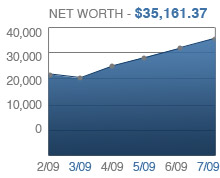


 Posts
Posts


