
I am extremely bullish on silver. My research tells me that 2012 is going to be a good year for the white metal, not that it matters but my gut tells me the same(never invest because your gut tells you). We are investing in silver and I personally believe that it is going to be one of the best investments not only in the next 5 years but might be the best investment opportunity in my lifetime. Only time will tell, and it will be fun to look back and see this statement, because overall that is a pretty bold statement for someone in their 30's, and hopefully I will have a long life ahead of me.
We started looking into silver in 2008 when the price pulled back strongly to around 8-10 dollars. I watched it for six months regularly as it climbed up to $16. While I was watching the price I was doing research on the fundamentals of it. I was was also looking into the best way to purchase and store it. We finally pulled the trigger at the end of 2009 at around the spot price of $18, at this point I felt confident that it was worth putting some money into.
Over the last couple of years with investing in the PM market, I have done my due diligence and spent many countless hours studying and double checking the fundamentals to make sure that I/we had made the right decision. All you hear is that silver is volatile and its for speculators(which it is), but you never hear the fundamentals. During this time not only have I confirmed that I have made the right decision, but that I believe in it more than when I initially looked into it.
During the last two years, we have been dollar cost averaging and not trying to time the market, just regular accumulations of the metal each month, no matter the price. I believe I have a done really good job keeping my emotions in check with not worrying about the price but focus on purchasing it not matter the price and knowing that in the next few years trying to save 2-5 dollars per oz isn't going to matter.
We are now sitting in a good spot with our investment now and have our core position. I believe with the market swings, that I can start to play this investment a bit different. I believe that we can stop buying every month and save some cash for when the price swings to the downside. Then we can pick up some more at cheaper prices...or buy the dips. We still want to purchase more, I would love to purchase all the way up to around $50. I will re-asset once the price hit that mark.
Last year we saw a run up in silver from around $28 to $48 dollar over the summer and then back to finish around $28 at the end of the year. We purchased at $28 and also at $48, which overall, doesn't matter, because we also purchased at $18 and other prices during the last two years.
So far this year, the price started at around $28 and so far it's around $36 around 30%, and honestly its hard to watch the price going up and not think that you have missed the boat. I follow some blogs that follow the metal hourly and daily, most of the people on these blogs are as bullish, if not more bullish than myself. It is funny to read the comments about the price movements. You can start to see this timing the market mentality and I am surely guilty of it (reason of this post).
*UPDATE*
Before I could finish this post, Wed, around 10am Silver dropped from around 37.50 to under 34 which is over 7% drop. This was exactly what I was talking about, silver had been on a tear since the beginning of the year(up 30%). The 2011 ending for silver, everyone seemed defeated and some even seemed bearish on the overall trend(including me). Now the night before(Tuesday) everyone on these blogs thought they had missed the boat and that silver was going to the moon without pulling back and taking a breather. I remember telling myself that I just need to relax and let the price come back down.
Anyways, I just need to remain level headed and keep my emotions in check. We have our core position and I think that we will be well rewarded come one, two, three, etc..years down the road. A lot can change during this time and I will be watching very closely and seeing if the fundamentals change or if it is time to move our money into something that is more undervalued than silver.
I have seen how the market trade on greed and fear, and experienced it first hand.
Here is a great presentation from David Morgan on silver:
Showing posts with label investments. Show all posts
Showing posts with label investments. Show all posts
Friday, March 2, 2012


Sunday, January 1, 2012
2011 Year End Update - 2012 Here We Come


Another blessed year comes to a close and despite the rocky road, we are still gaining...slowly.
2011 brought a lot of hills and valleys and especially with the portfolio. I believe this is due to the insurance/investments in the precious metals.
Even though Gold is solid and remained in the 11year uptrend finishing up 10%, silver on the other hand started the year at $30.67oz and ran up to $48.70, only to finish down around 1% at $28.18. With that, we saw the net worth move upwards fairly fast and downwardly fast.
One place I feel like we might have mismanaged was more in cash and less in stocks/brokerage account.
Lets break it down:
Cash & Savings: Looking back on this year, I have to say that I probably mismanaged this area a bit. I really wanted to to get to 50K in cash. The reason for this is that we are still trying to get our core position for our in PMs. Our goal in 2012 is to get 50k sitting in cash in this bucket.
Stocks/Brokerage: 2011 saw a payoff to some selling of a few of our stocks. Eldorado Gold Corp(EGO) $269.67 +53%, Fronteer Gold(FRG) $517.38 +64%, Avalon Rare Metals(AVL) $886.82 +189%, Quicksilver(ZQK) $20.73 +42% Stocks sold for a loss - Proshares Ultra Silver(AGQ) -$55.54 -19% Ultrashort S&P500 Proshares(SDS) -$139.46 -34%.
Overall, what we sold this year, we were up $1209.46 a gain of +59%.
Stocks/Brokerage: 2011 saw a payoff to some selling of a few of our stocks. Eldorado Gold Corp(EGO) $269.67 +53%, Fronteer Gold(FRG) $517.38 +64%, Avalon Rare Metals(AVL) $886.82 +189%, Quicksilver(ZQK) $20.73 +42% Stocks sold for a loss - Proshares Ultra Silver(AGQ) -$55.54 -19% Ultrashort S&P500 Proshares(SDS) -$139.46 -34%.
Overall, what we sold this year, we were up $1209.46 a gain of +59%.
Here are the gains/losses based of percentages this year. Currently down 8% for 2011, I try and keep a level head and not get to excited or depressed on prices, investing in commodities/energy you see wild swings in the market. We saw our uranium stock drop 50% after the Japan earthquake this year.

*As you can see we are heavy in commodities in my brokerage account. This is all based on my thought that over the next decade the best investments are going to actually be in hard assets and assets in the ground. My Roth/IRA/401k are in pretty common index funds and mutual funds so I figure I can go more risky with brokerage. I believe these will out perform equities in the next decade and if nothing else I feel more comfortable with my portfolio being diverse. I am bearish on the US Dollar and US Economy, I believe that 16 trillion dollar deficits are not going bode well for the USA.
Precious Metals: (Spot : Gold - $1531.00 / Silver - $28.18) (Gold/Silver Ratio: 54.32)(Dollar cost - 29.94) Precious Metals took a huge dive going into the end of the year. Gold was still up 10% and Silver down 1%. We remained dollar cost averaging in the whole year. Every 2-4 weeks we would purchase regardless of the price. The dollar cost averaging has allowed us not to try and time the market but just purchase as we get paid. The downside to this is that we purchased at the very top at $49. Even though we have made purchases when it was under $30 as well.
As it stands right now, we have a core position, and will be making purchases on dips and occasional times just to pick up some here and there. We are about half way to where I think we should be and this will increase with our overall net worth and the economics of the world/US.
As it stands right now, we have a core position, and will be making purchases on dips and occasional times just to pick up some here and there. We are about half way to where I think we should be and this will increase with our overall net worth and the economics of the world/US.
...we are currently investing mostly in silver which I plan to sell and purchase gold when the silver to gold ratio is 30/1 then 20/1 the finally 10/1 if it makes it that far which I do believe it will at least reach 16/1(its historic ratio). I plan on always owning silver and gold bullion to pass along to my kids/grandchildren. We own silver as an investment and we hold gold as an insurance policy on our investments. We currently prefer to keep a percentage of our wealth in PMs instead of federal reserve paper(dollar bills).
Retirement 401k: This will jump up an bit more as I haven't been counting my wife's retirement this year. I believe it should be around an extra 5k.
Retirement IRA's: This category didn't have a great year and we actually were negative...I have been sitting in cash in some of this and the emerging markets and total stock market funds along with the precious metals funds didn't seem to perform particularly well this past year. I am currently looking to use some of the cash on the sideline go to work in their dividend paying funds. Current funds we are in: (VDIGX, VWELX, VGSTX, VEIEX, VGPMX)
Real Estate: The plan remains to keep our money that we were going to put down as a down payment in the bank or investments. We will try and hedge our payments with trying to pay off the home in 10-15 yrs depending on what comes our way. This might change along the way depending on kids, economy, jobs and so forth.
Debts and Liabilities -
Credit Cards: We currently do not hold debt in this category and prey that we never have to.
Car Loan: First vehicle is paid off, it is currently 5 years old and is going to be the family car going forward since it is a SUV. After long debates and figuring out what is best for our family, we decided to purchase a new Prius. Our reasoning being that was that the second car was getting old and needed more and more service, but yet it still had good trade in value. Also with a kid on the way, a two door just wasn't going to cut in any longer. We travel to family and to the beach a lot and we just were not going to have the room to pull it off any longer. We decided on a gas efficient car since we travel to family and I travel to work everyday. We also believe that gas is not going be cheap(relatively) ever again.
Home Mortgage: Mostly paying interest on our home at the moment, so not much of a dent here.
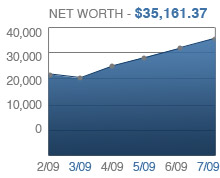
Hard to believe 2011 came and went as fast has it has and that we are still doing such a great job with our finances. Even a small 6K jump in our net worth, which is a bit deceiving, since we went 22k into the vehicle debt. I feel like we are on the right path and we just need to keep doing what we are doing.
Headed into 2012, we now have a kid on the way now and the stakes are starting to get a bit more serious and real. We have decided to go back onto a budget and try and live off my salary only. Hopefully we can pull it off and save a lot over the next five months before the kid arrives.
We are starting to raise as much cash a possible and hopefully we will have close to a year worth of savings(salary) saved for when the kiddo comes. Well, guess this is it for 2011, welcome 2012!
Headed into 2012, we now have a kid on the way now and the stakes are starting to get a bit more serious and real. We have decided to go back onto a budget and try and live off my salary only. Hopefully we can pull it off and save a lot over the next five months before the kid arrives.
We are starting to raise as much cash a possible and hopefully we will have close to a year worth of savings(salary) saved for when the kiddo comes. Well, guess this is it for 2011, welcome 2012!
Thursday, April 28, 2011
Thursday, April 7, 2011
Wednesday, August 25, 2010
Tuesday, July 20, 2010
Saturday, February 27, 2010
Weekend Listening: James Dines Author of GOLDBUG!
This is one of the most interesting and most entertaining interview I have heard. I would take the time and listen to this interview. This is from Financial Sense Newshour Enjoy!
James Dines has become legendary for having made correct forecasts that were in complete contradiction to the rest of the financial community. He has a new book called "GOLDBUG!"
James Dines has become legendary for having made correct forecasts that were in complete contradiction to the rest of the financial community. He has a new book called "GOLDBUG!"
Friday, January 15, 2010
Thoughts from Chumbawamba
Here is some thoughts from (Chumbawamba) poster over at Zerohedge.com:
In a nutshell (because my education took years, so you can't expect me to give you the important background to my argument in one posting, or even several) this system is f*cked. Our debt-to-GDP ration is well beyond what other empires experienced just before their collapse. Our central bank is monetizing thin air to pay off the financial blackholes created by unregulated/out-of-control over-the-counter derivatives that are valued at well over $600 trillion globally, and our government is planning to borrow every last unit of currency under the moon in order to keep from falling into a fiscal abyss. How the hell does anyone expect this is going to turn out anything but very, very badly?
There are now literally tens of trillions of dollars of liabilities stretching from here on decades into the future. Our debt-based monetary system means these liabilities will only increase in cost and interest as time goes on. From where are the revenues going to come? The pace of productivity and wealth creation in this nation will have to inflate accordingly. How is this going to be accomplished? Do you have any answers? Does anyone?
We took a quantum leap from billions to trillions--a thousand-fold increase--in our economic discourse. It follows then that our GDP will have track this increase to keep up with the new normal. Again, from where are the revenues going to come? Are they going to be conjured up again like magic, so that we go from trillions to quadrillions as the new new normal? Or are you going to be expected to magically increase your productive output 1000 times to make up the difference, along with every other American (including children 1 and older, since we’ll also be needing more manpower for the job, way more than we have even if you include the illegals)?
WHO IS GOING TO PAY FOR ALL OF THIS?
The answer never comes. Oh yeah, this is simple to solve, they say. They'll just "add liquidity" to the market, then "drain it", as if this was just a matter of doing the dishes, and all the complaining and fussing and fearing and loathing and hemming and hawing was all just a matter of no one wanting to pony up to the sink to actually do the deed. But no, that’s just a cheap distraction. So the question remains:
WHO IS GOING TO PAY FOR ALL OF THIS?
I’ll tell you who: Us. As in you. And I. Or at least those of us that are silly enough to file and pay taxes (I don't know about you two, but I do not submit to extortion, otherwise known by the letters I-R-S). And how many people like me do you think there are now? Probably just a relative few. We're the "out there" nutballs. We're the ones that make wild-eye predictions of economic collapse and social chaos to follow. We're the ones who get pooh-poohed. Until the government keeps pulling shit like this. Then we grow in numbers. The disgusted; the disenfranchised; the disaffected. We find each other, learn from each other, and spread the wisdom. We watch as the government creeps upon our God-given freedoms like a depraved predator, one after the other, picking them off until one day we’ll be left naked and defenseless. But we prepare, and in the meantime we keep introducing new people to the mouth of the rabbit hole. And if you’re courageous, and intelligent, you’ll go in. And the deeper down the rabbit hole you go, the more you realize that real money—gold and silver—is the answer.
As more people discover the answer, the dollar takes one step closer to irrelevancy. Once it reaches that point, you have hyperinflation. Once the dollar enters hyperinflation the game is over; or rather, it just begins. But then that's a matter of perspective :)
Will the dollar cross that line of confidence? After all of my study, I sincerely believe it will and am convinced beyond a shadow of doubt about that conviction. I’ve been waiting for someone to come along and explain how I’m wrong about this. Despite my rhetoric, my eyes and mind are open. Convince me. Anyone?
In short: follow Austrian school of economics. I'm not saying they have ALL the answers, but so far it seems they have pretty damn nearly all of them.----------------------------------Ask yourself these questions:
1) What system is collapsing? The one in the US? I.E. the dollar?
1a) If the dollar collapses, what does that mean domestically?
1b) What does it mean internationally?
2) Is the FDIC solvent?
2a) If not, how safe are your bank accounts?
3) Are the firms in which you have your various retirement accounts solvent?
3a) Really? Are you sure? Did you check their balance sheet?
3b) Including all their hidden liabilities?
3c) If not, how safe are you accounts with them?
4) Does America strike you as a financially strong country?
4a) If not, do you think America will remain the world's sole superpower indefinitely under these conditions?
4b) If not, what does that mean for the dollar, the world's reserve currency, and the unit of account upon which all other world currencies (except gold) are based (again, domestically and internationally)?
Mull that over.
But here's a spoiler. The answer to all the above is:
Don't wait until inflation eats away your savings. Every day you wait is like an ounce of silver slipping out of your hands, lost forever.
History is your teacher. All others are substitutes. Including me.
I am Chumbawamba.
This might seem extreme, but he does ask some tough questions...cannot say I disagree and yes I tend to ignore what he says but doesn't mean that I don't feel this way down deep within my beliefs.
Thursday, December 3, 2009
Gold Thoughts: Arnold Bock
The following is Copyright © 2009 Arnold Bock and can be found over at Financial Sense.
So why am I so optimistic about the eventual price of gold?
So why am I so optimistic about the eventual price of gold?
It is because an affinity for and an understanding of the political mindset causes me to understand what decision makers will do…and why. Because a politician follows the political calendar, s/he only concerns himself/herself with the time horizon leading to the next election.
Anything requiring decisions beyond the date of the next election will be the responsibility of whoever is on the next watch. If the politician in office today is in office after the next election, a shrug of the shoulder indicates that worries of that kind can be dismissed for now to be dealt with later.
So major and difficult, but necessary, decisions are inevitably deferred. In their place spending money gives the appearance of concern and of doing something to fix the apparent problem. Aren’t those elected officials doing what we elected them to do? It certainly looks as if they are.
More cynical observers would characterize these actions by the political class and their senior bureaucratic minions as buying time hoping that something positive might magically emerge.
Those who are super cynical would even conclude give-away programs are designed simply to bribe the voters in order to curry goodwill for another term at the levers of power.
What all this means is that there is no discipline or inclination to do anything of real value in fixing the core economic and financial problems. That being the case, new programs, more spending stimulus and money creation will always be the order of the day. Hence the currency will devalue and investors will find gold as their best safe-haven refuge.
The dollar will devalue because massive dilution caused by incessant money creation allows future obligations to become more manageable – for government – because it is the only way that it can meet its future obligations for employee pensions, accumulated debt, Medicare and social security.
A nominal dollar which buys much less in the future than it does today is still a dollar. Unfortunately the holders or recipients of those devalued pieces of paper will find they are essentially fraudulent promises.
These realities make gold the closest thing to a sure-bet investment. They are also the reasons why gold will go much higher than most of us allow ourselves to contemplate.
Buckle your seatbelts and enjoy the ride ahead!
I still think Gold is overbought, it is always a good reminder to keep myself honest by reading stuff like this. I have a lot of events coming up this year wedding, honeymoon, trying to buy house, etc...With all these I am going to need liquidity and not sure holding on to bullion is going to be my best option. I am looking to buy some on the dip (if that ever happens) think I might as well get into som Sliver and Oil.
Tuesday, November 24, 2009
Timing the Market
I feel like this sometimes, good thing my risk tolerance is strong...I am just praying that the game hasn't changed like some are saying because I have a lot riding on long term investments. This even while I hold my IRA in cash at the moment.

Wednesday, July 22, 2009
Truth Behind Common Financial Advice and Conventional Wisdom
This is a guest post by Mr Credit Card from www.askmrcreditcard.com. Mr Credit Card normally writes about credit card reviews, debt reduction topics and his site obviously has got tons of credit card offers. He has also put together a list of the best credit card offers and deals. Please check out his blog and subscribe to his rss feed. Today, Mr Credit Card is going to branch out and write about a topic that we should all be aware of. So here is his post
If you read the mainstream press and even most personal finance blogs, you will have come across many standard common advice. However, if you look deeper into these "standard advice or thinking", you will find that most of them are just not true or that it comes with a few caveats. Today, I am going to highlight some of these and hope that you will be more discerning whenever the mainstream press gives any so called "standard" advice.
The stock market always goes up in the long run - This common statement derived from studies in the US only from 1926 till present day. Some studies went further back to the late 1800s and came to the same conclusion. Based on this "empirical evidence", the common advice now had been to telling folks that in the 'long run', stocks are always the place to be. Problem with this analysis is that there are many assumptions that have been left out.
The first is that this study holds true only in the US because the United States. In countries like Russia (where communism happened in 1917, or parts of Europe, where there were 2 major world wars in the last century, or even in South America), this conclusion is simply nonsense. Germany went through hyperinflation in the 1930s and a change in currency. One that was pegged to gold and one that was not. South American countries went from being the richest nations in the world to one with massive debt problems in the 80s and 90s. If you were living in those countries, this 1926 US stock market analysis is meaningless when your country faces crisis of epic proportions.
Truth - It only went up in the US (and perhaps Britain) from the time frame of analysis. But bear in mind that the US has not been conquered in war in the last century. We have not had massive currency devaluations or flight of capital. Being careful of the definition of long run. There have been 20 year stretches where the US stock markets did nothing. So if you do not have a 20 year horizon or longer, be very wary about putting the bulk of your money in stocks.
US treasury bills and bonds are the safest investments - The US government treasury bills is considered the safest investments because the US government has never defaulted on its debt obligations. And hence, its historical yield is used in calculations. Because of such assumptions, academics have used the yields on treasury bills as the "risk free asset" (for those of you who study CAPM and stuff). However, there are some flaws to this assumptions.
But in the 1930s, President Roosevelt devalued the dollar by more than half when the dollar was re-pegged to Gold. In the 1970s, President Nixon took the dollar off the gold standard after the French President Charles DeGaulle wanted to exchange the French US Dollar Holdings for gold! In the 1950s, interest rates on long bonds was actually capped at 2+%!
Truth - While in many instances, US T-bills can be considered the safest assets, this only holds true if the US currency does not devalue massively. Today, we are seeing signs that countries like China are wary about their US Dollar reserves and also do not like the fact that the US Dollar's role as the international currency of choice means that we can get away with deficit spending. There is no guarantee that the dollar may lose it's reserve currency stature in future and if that happens, the US dollar will have depreciated a long way. Moral of the story is : have some of your other savings in other currencies and study how to keep your money safe. Perhaps, some gold investments would be good for you?
Reaching a retirement savings of a million dollars is a desirable goal - Another one of those myths that floats around the mainstream media. What puzzles me is that nobody questions this number at all. If a great retirement is your goal, I think that you will find that this number is really not enough. Why?
Using monte carlo analysis, it has determined that by withdrawing up to 4% of your retirement nest egg, you have a more than 85% chance of having your portfolio intact after 30 years. 4% of $1mm is $40,000 a year. And this is after tax money. Firstly, I doubt anyone can live with that amount in a high cost city like New York. Secondly, after factoring in health insurance and all other cost, there ain't much left!
What the mainstream media fail to tell folks is that planning for a career in "retirement" is more important than just "saving for retirement" itself. Afterall, savings can evaporate (ask anyone what happened to their 401ks in 2008). Your countries currency can become worthless (ask any middle Argentinian, or Russian). In the 30s, Germany went through hyperinflation.
Truth - With inflationary monetary policy as part of the western developed world for the last century, the whole million dollar is enough notion will face greater scrutiny sooner or later. You'll probably need much more to enjoy the same standard of living as you have now. If you are earning $100,000 a year today, based on 4% withdrawal rate, you'll need $4 million in retirement savings to have a good chance of achieving the same standard of living.
Small Deficits are OK - The US government has no problems perpetually running budget deficits (saying 3% deficit is OK!). All I can say is that if any household runs a budget deficit for too long, they will sooner or later have to file for bankruptcy. Well, I guess developed countries government like the US can run budget deficits for a longer time than most ordinary households. But sooner or later one's past sins will always catch up.
Deficit spending has a nasty habit of being justified by something that is "really needed". We need to provide health care (very expensive) for the elderly. We need massive military spending. We are fighting two wars. We need to spend money on various programs.
But this mentality spills over to our individual's personal financial life as well. Many folks will say it is "OK" to put the plumbing repairs on the credit card, because we'll "pay it off soon"! Problem is that just like the federal government, most folks do not pay it off. Once in a while, certain "freebies" come along that make our debt load easier. In the case of the federal government, easy monetary policy allows US government debt to be issued at relatively low interest rates. The easy monetary policy has trickled down into the consumer world via promotions like 0% financing for cars, 0% balance transfer credit cards, or even low interest credit cards. For quite long periods of time, these easy monetary policies enabled the federal government and US consumers to "fund deficit spending".
Truth - Debt should be shunned at all cost. What starts as a small amount eventually becomes a habit that becomes very hard to kick.
Global Savings Glut by Emerging Countries Responsible for Global Imbalance - Here's another common economist rant. China, and the Asian emerging economies are savers (which everyone actually acknowledges is good). But they save too much! Because global trade is conducted in US Dollars, countries with trade surpluses have excess savings in US Dollars. And the dollars has to be invested somewhere. The most natural home is US treasuries (ie US government debt). Hence, even if the US is running a persistent budget deficit, savers abroad have no where else but to invest with us. The result for all that is that interest rates and mortgage rates remained low even though our debt picture shouldn't have allowed it.
So what do we tell China and the rest of the world's savers? Don't save so much. Introduce social welfare and health care so people do not have to save so much and they can "spend"! This is one of the worst advice I've heard. We have trouble controlling spending in medicare and social security and now we're telling savers to follow our vices!.
Truth - Truth is the problem is not with savings. It is with the fact that the world conducts it's commerce mainly in US dollars. Savings is the only way to wealth. Savings (just like an emergency fund) gives you cushion. China, for example, could pump billions into their economy without having to borrow from anyone! The good old US however authorized over $700 billion in spending (which by the way they printed!) and they actually have to borrow it from the financial markets. And that is the big problem with having debt. You have to keep issuing IOUs! China's billions was simply gotten by converting their US dollars reserves into Yuan! In personal finance, the same principals apply. When you have debt, whether it is a mortgage, a home equity line of credit or credit card debt, you are constantly on the treadmill trying to find a better card or loan with a better rate. Contrast that to someone who, for example, pays his balance in full. That person can actually use a cash back credit card or gas credit cards to earn cash rebates. Unlike the person having to pay down his or her balance, the person paying in full actually makes money!
Term Life Insurance is Always Better Than Whole Life - Here is another phrase that has been hyped up by the Suze Ormans of the world and literally the whole finance bloggers world. Everyone hates whole life. What nobody has ever properly explained is the cons of term life. So let's look at a few here:
Term life insurance ends after a term - proponents would claim that
1. You can save the money on whole life and invest the difference
2. You do not need insurance after 20 or 30 years cos you have saved enough
3. Term is more cost effective
Problem is nobody tells the downside. The first downside is that
1. The annual premium for term life goes up every year!
2. To maintain the same insurance, you have to keep paying premiums every year. When you are retired and have no "work income" but only portfolio income, monthly payments are a really pain in the B***. For whole life, once you have paid up, it really means you have paid up!
3. By the time you are 50 or 60, you may not have saved enough and your beneficiaries still need money from insurance if you pass away!
4. You have a disabled child and whole life or permanent insurance is the only way to fund it (after all, their needs are permanent!)
Truth - Term life may or may not be more suitable for you. It really depends on your particular situation.
I think I'll stop here. I hope this post makes you think harder and question common teachings and assumptions in the world of personal finance, or anything in fact.
Please leave a comment and tell Mr. Credit Card your thoughts.
If you read the mainstream press and even most personal finance blogs, you will have come across many standard common advice. However, if you look deeper into these "standard advice or thinking", you will find that most of them are just not true or that it comes with a few caveats. Today, I am going to highlight some of these and hope that you will be more discerning whenever the mainstream press gives any so called "standard" advice.
The stock market always goes up in the long run - This common statement derived from studies in the US only from 1926 till present day. Some studies went further back to the late 1800s and came to the same conclusion. Based on this "empirical evidence", the common advice now had been to telling folks that in the 'long run', stocks are always the place to be. Problem with this analysis is that there are many assumptions that have been left out.
The first is that this study holds true only in the US because the United States. In countries like Russia (where communism happened in 1917, or parts of Europe, where there were 2 major world wars in the last century, or even in South America), this conclusion is simply nonsense. Germany went through hyperinflation in the 1930s and a change in currency. One that was pegged to gold and one that was not. South American countries went from being the richest nations in the world to one with massive debt problems in the 80s and 90s. If you were living in those countries, this 1926 US stock market analysis is meaningless when your country faces crisis of epic proportions.
Truth - It only went up in the US (and perhaps Britain) from the time frame of analysis. But bear in mind that the US has not been conquered in war in the last century. We have not had massive currency devaluations or flight of capital. Being careful of the definition of long run. There have been 20 year stretches where the US stock markets did nothing. So if you do not have a 20 year horizon or longer, be very wary about putting the bulk of your money in stocks.
US treasury bills and bonds are the safest investments - The US government treasury bills is considered the safest investments because the US government has never defaulted on its debt obligations. And hence, its historical yield is used in calculations. Because of such assumptions, academics have used the yields on treasury bills as the "risk free asset" (for those of you who study CAPM and stuff). However, there are some flaws to this assumptions.
But in the 1930s, President Roosevelt devalued the dollar by more than half when the dollar was re-pegged to Gold. In the 1970s, President Nixon took the dollar off the gold standard after the French President Charles DeGaulle wanted to exchange the French US Dollar Holdings for gold! In the 1950s, interest rates on long bonds was actually capped at 2+%!
Truth - While in many instances, US T-bills can be considered the safest assets, this only holds true if the US currency does not devalue massively. Today, we are seeing signs that countries like China are wary about their US Dollar reserves and also do not like the fact that the US Dollar's role as the international currency of choice means that we can get away with deficit spending. There is no guarantee that the dollar may lose it's reserve currency stature in future and if that happens, the US dollar will have depreciated a long way. Moral of the story is : have some of your other savings in other currencies and study how to keep your money safe. Perhaps, some gold investments would be good for you?
Reaching a retirement savings of a million dollars is a desirable goal - Another one of those myths that floats around the mainstream media. What puzzles me is that nobody questions this number at all. If a great retirement is your goal, I think that you will find that this number is really not enough. Why?
Using monte carlo analysis, it has determined that by withdrawing up to 4% of your retirement nest egg, you have a more than 85% chance of having your portfolio intact after 30 years. 4% of $1mm is $40,000 a year. And this is after tax money. Firstly, I doubt anyone can live with that amount in a high cost city like New York. Secondly, after factoring in health insurance and all other cost, there ain't much left!
What the mainstream media fail to tell folks is that planning for a career in "retirement" is more important than just "saving for retirement" itself. Afterall, savings can evaporate (ask anyone what happened to their 401ks in 2008). Your countries currency can become worthless (ask any middle Argentinian, or Russian). In the 30s, Germany went through hyperinflation.
Truth - With inflationary monetary policy as part of the western developed world for the last century, the whole million dollar is enough notion will face greater scrutiny sooner or later. You'll probably need much more to enjoy the same standard of living as you have now. If you are earning $100,000 a year today, based on 4% withdrawal rate, you'll need $4 million in retirement savings to have a good chance of achieving the same standard of living.
Small Deficits are OK - The US government has no problems perpetually running budget deficits (saying 3% deficit is OK!). All I can say is that if any household runs a budget deficit for too long, they will sooner or later have to file for bankruptcy. Well, I guess developed countries government like the US can run budget deficits for a longer time than most ordinary households. But sooner or later one's past sins will always catch up.
Deficit spending has a nasty habit of being justified by something that is "really needed". We need to provide health care (very expensive) for the elderly. We need massive military spending. We are fighting two wars. We need to spend money on various programs.
But this mentality spills over to our individual's personal financial life as well. Many folks will say it is "OK" to put the plumbing repairs on the credit card, because we'll "pay it off soon"! Problem is that just like the federal government, most folks do not pay it off. Once in a while, certain "freebies" come along that make our debt load easier. In the case of the federal government, easy monetary policy allows US government debt to be issued at relatively low interest rates. The easy monetary policy has trickled down into the consumer world via promotions like 0% financing for cars, 0% balance transfer credit cards, or even low interest credit cards. For quite long periods of time, these easy monetary policies enabled the federal government and US consumers to "fund deficit spending".
Truth - Debt should be shunned at all cost. What starts as a small amount eventually becomes a habit that becomes very hard to kick.
Global Savings Glut by Emerging Countries Responsible for Global Imbalance - Here's another common economist rant. China, and the Asian emerging economies are savers (which everyone actually acknowledges is good). But they save too much! Because global trade is conducted in US Dollars, countries with trade surpluses have excess savings in US Dollars. And the dollars has to be invested somewhere. The most natural home is US treasuries (ie US government debt). Hence, even if the US is running a persistent budget deficit, savers abroad have no where else but to invest with us. The result for all that is that interest rates and mortgage rates remained low even though our debt picture shouldn't have allowed it.
So what do we tell China and the rest of the world's savers? Don't save so much. Introduce social welfare and health care so people do not have to save so much and they can "spend"! This is one of the worst advice I've heard. We have trouble controlling spending in medicare and social security and now we're telling savers to follow our vices!.
Truth - Truth is the problem is not with savings. It is with the fact that the world conducts it's commerce mainly in US dollars. Savings is the only way to wealth. Savings (just like an emergency fund) gives you cushion. China, for example, could pump billions into their economy without having to borrow from anyone! The good old US however authorized over $700 billion in spending (which by the way they printed!) and they actually have to borrow it from the financial markets. And that is the big problem with having debt. You have to keep issuing IOUs! China's billions was simply gotten by converting their US dollars reserves into Yuan! In personal finance, the same principals apply. When you have debt, whether it is a mortgage, a home equity line of credit or credit card debt, you are constantly on the treadmill trying to find a better card or loan with a better rate. Contrast that to someone who, for example, pays his balance in full. That person can actually use a cash back credit card or gas credit cards to earn cash rebates. Unlike the person having to pay down his or her balance, the person paying in full actually makes money!
Term Life Insurance is Always Better Than Whole Life - Here is another phrase that has been hyped up by the Suze Ormans of the world and literally the whole finance bloggers world. Everyone hates whole life. What nobody has ever properly explained is the cons of term life. So let's look at a few here:
Term life insurance ends after a term - proponents would claim that
1. You can save the money on whole life and invest the difference
2. You do not need insurance after 20 or 30 years cos you have saved enough
3. Term is more cost effective
Problem is nobody tells the downside. The first downside is that
1. The annual premium for term life goes up every year!
2. To maintain the same insurance, you have to keep paying premiums every year. When you are retired and have no "work income" but only portfolio income, monthly payments are a really pain in the B***. For whole life, once you have paid up, it really means you have paid up!
3. By the time you are 50 or 60, you may not have saved enough and your beneficiaries still need money from insurance if you pass away!
4. You have a disabled child and whole life or permanent insurance is the only way to fund it (after all, their needs are permanent!)
Truth - Term life may or may not be more suitable for you. It really depends on your particular situation.
I think I'll stop here. I hope this post makes you think harder and question common teachings and assumptions in the world of personal finance, or anything in fact.
Please leave a comment and tell Mr. Credit Card your thoughts.
Friday, July 10, 2009
The 4 different Scenarios: Keeping Your Money Safe
 I had a conversation with a friend earlier this week about how he see the market playing out over the next 5 years. My friend works in the financial sector and has worked for companies such as GE Financial along with having a finance degree. Some of our discussion was around all the different scenarios that we might see and how bad is everything.
I also mentioned earlier in a post this week that I was thinking about purchasing some shares in some ETF's that short the financials. After talking with him about this, these are some of his main points and what he is doing with his money*.
Not to say there isn't a chance for deflation or shorting bank stocks or real estate is a bad idea. I also believe banks are in much worse shape than they are currently showing on their balance sheets. I still believe that the government will continue to prop them up and won't let the bankin system collapse. That doesn't mean there's not going to be huge implications for the governments actions.
I think it makes sense to spread your bets around. I see 4 different scenarios that could occur:
Hyperinflation = 10%
Stagflation = 40%
Deflation = 25%
Back to Normal = 25%Hyperinflation:
Good Investments: Gold, most commodities, very little else.Bad investments: bonds, cash, most stocks
Stagflation:Good Investment: gold & staple commodities (oil, gas, food), utilties (maybe, in the 70s utitilies weren't a good investment).Bad investments: most bonds, most stocks, cash
Deflation:Good investments: Cash, treasuries, high grade corporate bonds, high yield staple stocks (utilities), even gold has done well in this environment in the past and could potentially outperfm here as well.
Back to Normal:Good investments:Industrials, Tech, Energy, Banking (although I still wouldn't go long here).Bad investments: Gold will do poorly here
So my opinion for long term investing is to spread your bets accordingly based off the above. My target portfolio with a 5 year time horizon is:
30% = Precious Metals (includes actual bullion/metal and stocks of PM producers)
30% = USD Cash, FX Cash, Short Term Bonds (this is to hedge by PM trade, have an allocation to cash if there is deflation, and to have as ammunition when the market tanks again (so I can buy what I like)
20% = Energy/Agriculture both the actual commodities through ETFs and stocks (domestic and int'l stocks)
20% = Industrial, Tech, Healtchare, Utilities (domestic and int'l stocks)
He has studies the stock market and his investments for at least 2 hours a day. He has been doing this since he graduated college so whether he is right or wrong, he has put in the research. Again take all this with a grain of salt because no one really know what is going to happen over the next few years. What about me? Well, I still trying to figure it all out...I have a percentage going into my 401k and some going to my Roth IRA(mostly index funds) and the rest right now is sitting on the sideline in cash for possibly a down payment on a home.
So what scenario do you think is going to play out over the next 5-10 years? How are you protecting your investments? Leave me a comment.
Tuesday, July 7, 2009
Dr. Doom & Gloom or Sunny Bono
 I don't know, but lately I just have been Dr. Doom & Gloom. I have been reading and studying experts about how to keep my money and investments safe during these shaky economic times we are seeing. You listen to me write a lot about how our government is making all the wrong moves with interfering with banks, businesses, wall street, automobiles, and now energy and health care. I truly believe we are going through an extraordinary time in the history of America. I have talked with friends, family, and even strangers and no one can talk me into believing that what our government is doing is going to help out.
One side I have been studying is the Ron Paul, Peter Schiff, and Jim Rogers outlook. If you are a regular reader of this blog you will know their outlook and their beliefs in that we are going to see hyperinflation and they suggest purchasing gold. I have the most confidence in these guys and I am sure we will see inflation at some point over the next 3-6 years.
Another side I have been studying is Harry Dent, Nick Guarino, and Joe Saluzzi who predict there is going to be another Great Depression and a run on the markets. Harry and Nick think that we are going through a deflationary period and that all the banks are completely broke. I agree with them as well that all the major financials are completely broke. If not, why would our government feel the need to step in and bail them out. Also, just wait till the commercial real estate bubble burst, we will be seeing more banks going under than we already are. They say, eventually it will all collapse and that is probably the case unless we go through a period of hyperinflation because of the government intervention.
I have also been been following a couple energy guys Chris Nelder and Gregor Macdonald that think we are going through a period of Inflation and Deflation. And I tell you what, these guys are thinkers and they factor in energy so I am not ignoring these guys for one second.
So as you can see I have no idea what to do. I think the best thing I can do is hedge against everything in hopes there is no big swing one way or another. I have been throwing around the idea of buying Gold, I just do not know enough about it. Also, lately I have been thinking of buying some shares of SKF or FAZ (ETF's that shorts financials). I called a friend last night and talked to him about it and he doesn't like it because he thinks no matter how bad the shape of financials are, we do not know what the government is going to do which can ultimately effect the price of these. He mentioned SDS which is a ETF that shorts the S&P and he suggested that more so than the others. I would hedge by investing in money that I would be willing to lose if it did not work out.
As of right now I am still in limbo. I still have money going into my 401k, and Roth IRA. I am seriously thinking about pulling most of my money back into cash and let it sit on the sidelines if A) the market goes to 10,000 or B) if we are still stagnate mid to end of July. I think the market is going to take a long long time to correct itself and as long as the government is making moves I am going to be watching very carefully.
I do not suggest anyone follow my advice because I am forming my own opinion and even experts cannot agree on what is going to happen. How can I sit here though and post about how I think our government is going to do harm to our economy and personal finances without actually living by what I preach.
Again I am not making any drastic moves right now, and it could all change next week. I will keep you posted with the next moves I am going to be making.
Am I just over thinking? Should I be so concerned? What the hell do I do with my money? Who's right, inflation, deflation, or stagnation? Leave a comment
Monday, June 29, 2009
Is Gold a Good Investment?
 Lately you hear people talking about Gold more and more, and you hear them saying to buy it, and buy as much as you can. There seem to be a lot of crazy ideas going on about Gold, experts like Peter Schiff who I respect and who called the real estate bubble says that Gold could go as high as $2000 an ounce. There are also crazy late night infomercials cash for gold where you send in your gold for a very small amount of cash. Then there are some that claim it's time to start shorting Gold. So the question remains, is "Is Gold a Good Investment"? Well for one thing it is not an investment at all, buyers are "speculating" on its future price, they are not investing in a growing business, nonetheless it can be useful to investors.
Gold has also been used in the past as currency for different cultures for thousands of years. Up until 1971, all US dollars were convertible into gold on demand. This itself makes it very unique from other commodities not to mention all the other things gold has been used for over the span of 5000 years.
Barry Ritholtz has some interesting takes on gold, some of his points are:
In times of turmoil, gold always seem to be a safe haven. Gold has not been dependent upon any state or government, unlike paper currency, its worth comes from the willingness of people over history to assign a specific value.
He also says:
"Gold is a store of value, a way to maintain wealth over time(capital preservation);stocks on the other hand, represent a way to generate a return on value(capital growth)."
"Equities do well when there is low inflation(and no deflation), stable currency, economic growth, strong property rights, the rule of law and most of all, political and economic stability."
The exact opposite conditions are good for gold's value. We are seeing just that with the price of gold. The global economy has been hit with inflation over the last half decade (because the U.S. Federal Reserve ultra low rates after the 2001 market crash). Also we have been seeing no political stability with the last and present administrations (Bush driving us towards the cliff and instead of turning Obama is just stepping on the gas - Peter Schiff). Add to all this the Real Estate and Credit crisis and you have the perfect environment for gold prices to gain value.
So should we own gold? Barry Ritholtz says to consider 3 things:
1. Easy money has probably been made - gold went from $250-$1000 and since March 2008 gold has mostly gone sideways.
2.Contrarians like to buy assets that have become cheap and sell assets that have become dear. He has been bearish on stocks, but since they have been cut in half they have been constructive on equities. Some ETF's he did point out where (GLD, NEM, RGLD) as inflation hedges.
3. Since gold is a safe haven during periods of unrest, it could become more attractive if it unwinds even more. He says to watch and see if the spot price of gold moves above $1000 or if (GLD) trades above $100, he recommends buying in these circumstances.
As far as what I am doing, I am just sitting back and kinda watching. Gold works well as a inflation hedge. I think everyone should have a little bit for having a diversified portfolio. I would stay away from aggressively buying , unless the some of the circumstances change. And with this administration, anything can change, and as I see it, it is changing fast.
Leave a comment and let me know if you will be buying gold anytime soon. Should everyone have a little gold?
Friday, June 26, 2009
The Golden Rule: Don't have Debt
 In the personal finance world we all know that debt is the sure fire way to live moneyless and is the reason why people cannot create wealth. You know how I feel about debt and that we as a nation have to stop carrying debt from individuals, corporations, and mostly our government. If you don't care about those things I would highly suggest watching I.O.U.S.A. I believe for the most part, that a large majority of US consumers have figure this out and are working to cut down their debt. I am pretty sure that our government is doing the exact opposite as running up massive debt—which we will talk about later.
I came across an article yesterday on cnnmoney by Paul La Monica that talks about how companies with low debt loads are out performing stocks of firms that are in massive amounts of debt. Here are some interesting stats from the article:
According to figures from Thomson Baseline, shares of S&P 500 companies with a long-term debt to capital ratio below 34% -- the S&P 500 average -- are up an average of 10.3% this year. The S&P 500 stocks with debt loads above 34% are up only 1.2%.
This holds true for smaller companies too. Firms in the S&P SmallCap 600 with a below-average debt load are up 7.2% this year while those with higher debt loads are down 1.6%.Shares of S&P 500 firms that are debt-free are up an average of 15.6% this year. Debt-free tech giants Apple and Google have both surged more than 30%.
So we can see here as well, that for companies and personal investors, that debt is not the way to go. If you were to invest your hard earned money in a company, would you invest in a company whose balance sheet is pristine or in one that is carrying a load of debt?
Craig Callahan, founder of ICON Advisers, an investment firm with $3.5 billion in assets tells us why companies that have low debt have an advantage.
"In times like this, companies with high cash and low debt levels are in a better position to survive and take advantage of opportunities to grow through acquisitions,"
"Any type of financing is tough to come by. And in cyclical businesses, firms with no or little debt have a competitive advantage,"
Paul La Monica even names our good government handout buddies Lehman Brothers and General Motors along with General Growth Properties as example of companies that carried around to much debt. (note: why wouldn't they take on risk if they are going to get bailed out? General Growth Properties filed for bankruptcy) Callahan makes a great point when he says that companies with high cash and low debt levels are able to grow through acquisitions. Only if the government would allow companies to fail so other companies could buy up there assets and expand.
The golden rule here is pretty simple: don't have debt. Don't carry around personal debt, don't invest in companies that have debt, don't be a business that carries debt, and don't allow our government to spend us into nonsustaining debt. Why can everyone see this except our government?
Related Post
GM - Government MotorsCartoon by Marshall Gamsey from the Clarion Ledger
Would you invest in a company that was high in debt? Is debt ok for some individuals, businesses, or our government? Leave a comment!
Wednesday, May 27, 2009
Rockband: Why it is a Good Investment
 If you are a generation X or younger, you grew up with video games being a prominent part of your childhood and probably part of you adulthood. I can remember playing my college roommates for hours at John Madden and wasting a lot of valuable hours of my life in front of the TV. I can say that I have always enjoyed playing video games and I don't have a lot to show for it except a few bragging rights with friends.
As I became older and my life became fairly busy, I suddenly lost interest in wasting hours playing these games. I started to enjoy the outdoors more along with becoming active in my free time. In college, it seemed that all I had was free time besides studying and partying :). As you get older your free time starts to dwindle, so you have to enjoy every second of it. With that I started to get away from gaming based off the amount of money and time wasted on this sort of entertainment.
I decided this past Christmas that I wanted to get a gaming system, not so much to play every spare second, but to get the game RockBand. Everyone and their mother seem to have low cost hobbies for getting through the recession, this is just one way we have decided to save money and still have a good time. This weekend we went to the beach with a bunch of family and friends, instead of going out to the bars and spending money we stayed in and played Rockband. If you like music and/or karaoke it meets both these needs when it come to being entertained. We all stayed around the house and watched each other play while others socialized, but it might as well have been at a bar. We have been doing this more and more weekends, where we will invite friends over for dinner, and instead of going out and spending money at a bar, we break out Rockband and play till the end of the night.
RockBand sells from around $175(minus the gaming system), but I believe the return on investment is well worth it. We could easily spend $50-75 going out on a night on the town, so it only takes about 3-5 nights of staying in to pay for itself. It is hours of countless fun, but more interesting than sitting a bar wasting hours as well. For some reason you don't seem to drink as much either, you get caught up in playing the songs that you don't think about drinking all that much.
I would suggest anyone that has a gaming system that has been thinking about grabbing RB to save up and purchase it and invite some friends over to play. If you don't have a gaming system you can always do what my man J. Money over at Budgets Are Sexy and invite friends over to play Monopoly. What else are you doing to save money during this recession? Leave me a comment.
Tuesday, May 26, 2009
Jumping Ship: Moving Roth IRA to Vanguard
 Last week I decide to pull the trigger on moving my Roth IRA from Edward Jones to Vanguard. I have been contemplating doing this for a while, but just did not have the time to do it. One of the main reasons for switching the account over is so that I could have more control. I also wanted to make sure that I do my research and find out which investments are right for me.
I opened my Roth IRA in 2005 with Edward Jones with a tax return I had received. One of the first things I learned by opening this account was that the adviser was selling me on buying a fund with a front load of over 5%. I spoke with my father and we decided to go with a 1.45% load upfront with no yearly charge. Recently Edward Jones was getting rid of the fund I was investing in and I had to choose another one. Again I was was sold on changing over to a Fund which has a 5.75% load charge. With seeing how Vanguard's low investment cost are was the main factor that lead me away from Edward Jones and to take control of all my investment's myself.
One other thing that I learned as well with switching over is that the funds I have, have a fee if I moved money out of the fund before 7 years. It comes out to about between $140-160, which I don't want to lose, but in the long run I think it will be the best choice, especially since this year one of my goals is to max out my Roth. With keeping an Edward Jones account I have a yearly fee for them managing my account for around $40. I think I can make it up in the long run and no need to pay the extra fee when I could be investing that money.
It would not be fair to Edward Jones if I did not admit that I had a good experience using them. My adviser called me every quarter to check on me and told me some investments he liked. He was never pushy and he told me to reach out to him if I had any questions or investments I wanted him to check into. I believe Edward Jones is a great company for someone who isn't interested in doing all the work and don't mind someone else managing their money. Just with starting to look more closely to all my investments I feel this is the best decision for me and that it can save me some money in the long run.
Making the change over to Vanguard so far has been very nice experience, their customer service helped me with transferring everything over. They stayed on the phone with me and walked me step by step through the process. I have heard many bloggers speak highly of Vanguard and I am looking forward to my Roth being with Vanguard. If it is as good as I hope it is, I will be transferring my old 401k to a Vanguard IRA as well where I can mange most of my investments in one place instead of all over the place as of right now.
Did I make the right decisions? Let me know, also I have about 19 days before the money is completely transfered, I am researching different funds to purchase once the money is there. If you have any that you like leave me a comment and I will research it!
Thursday, April 16, 2009
Should you calculate a diamond in your net worth?
 So recently I bought a diamond ring for my girlfriend. I have been wondering once we get married do I included it in our net worth? I honestly don't want to because I feel it is not a true value of our net worth. I plan on never selling it and pray that nothing ever comes to that point, but I just don't see counting it unless I someday planned on liquidating it.
I did some research online a see what you should add and found this over at Money & Happiness here is an excerpt from here net worth article
"Next, imagine you have decided to sail around the world and liquidate everything you own, from the high-definition television on the wall to your four-carat diamond ring. You should ballpark everything..."I am sorry but I just don't feel like this is real assessment for my net worth, I don't like to account for my vehicle either. I just feel like its not making me wealthier? I will add my home value one day when we eventually own because we are building equity. A Home can gain value and lose value but a automobile just seems to always decrease in value, it is not a investment.
Does anyone else seem to think that I am in the wrong here and that I should be adding up jewelry and auto with my net worth? I am counting my automobile debt, and I am counting the debt for the ring (12 month 0% APR before someone gets made at me).
Please let me know so I can figure this out!
For more information about my net worth click here.
Friday, April 3, 2009
Vacation here we come!
 Today we are headed to California on vacation for a week. Keep checking back as I am trying to get a couple guest writers from people who have inspired me to work hard and to be smart with money. I wrote a couple of post last night so that I can be posting through next week.
In the meantime, here is 10 Reasons to be a Long-term Bull that I got in my last Edward Jones statement. Here is a link to the whole PDF.
1. The economy is bruised, but it’s not broken. Last year, the value of all goods and services produced in the United States (gross domestic product, or GDP) was $14 trillion. Americans earned $10 trillion in disposable income.
2. It’s not the Great Depression. Though many people like to compare today to the Great Depression, there hasn’t been a run on the banks. There are no widespread bread lines or soup kitchens.
3. Debt/deficits won’t crush the economy. Currently, the deficit is expected to be no higher than 15% – which is the highest since 1943. If you’re concerned that higher taxes may be imposed to pay for higher spending, consider investments that could help reduce future tax payments.
4. 50% drops historically have been an opportunity.
5. The government continues to support the financial system. While support for banks is controversial (and expensive), it’s designed to prevent the widespread panic and bank runs that occurred during the Great Depression. The Fed will continue to do more to support the credit markets and the economy, entering the market directly when necessary to lower mortgage and other rates if necessary.
6. Stock valuation is compelling. By almost any traditional measure of value, stocks have already priced in a lot of the bad economic news.
7. Inflation is under control. The Fed is keeping a close eye on inflation. However, if inflation does increase from its current level near zero to 2% – 3%, that’s probably a better scenario than deflation, or falling prices, which is a much tougher situation from which to recover.
8. When you feel bad, it can be good. High levels of fear and anxiety, which is often seen after the market has done most of its damage.
9. Good performance often follows bad. There have been only three negative 10-year periods since 1926, but the 10 years ended Dec. 31, 2008, were the worst (-1.4% per year). However, historically, good years have often followed bad ones. In each of the 12 10-year periods following those 10-year periods when market returns were less than 6%, the returns have averaged about 13%.
10. You still have long-term goals you are trying to achieve. A $100 investment that has fallen to $60 has lost 40%, but that investment must now rise 66% to break even. This can be difficult to achieve if the money is no longer invested.
Have a great weekend and even better week!
Wednesday, March 11, 2009
401k vs Roth IRA - Round 2
 So today I finally looked into what my best option was for either putting money into my company 401k or Roth IRA. I went and did some research on my companies HR site and found out that they are only matching up to 5% and not monthly but at the end of the year.
I'm not sure they will match until later but dont want to miss out if they decide to this year. I am currently putting in 8%, so this knock-down drag out fight still looks to be a draw. I dropped my contributions back to 5% and hopefully the company will match at the end of the year. In the meantime I will put the extra 3% in with my monthly contributions to my Roth. At the end of the day I still think this is the best decision and hopefully this will get me closer to my 2009 goal of maxing out my Roth. I also have my fingers crossed that the economy will turn around and will get my 5% matched come years end.
Subscribe to:
Posts (Atom)




 Posts


