More great stuff coming from twitter, I highly recommend following me and many others on twitter. Have a great weekend!

Visit msnbc.com for Breaking News, World News, and News about the Economy
85% of mankind is clueless & living on a hand-to-mouth basis. 5% of mankind is smart & pretty much knows what they are doing. 10% are intelligent enough to follow the 5%.
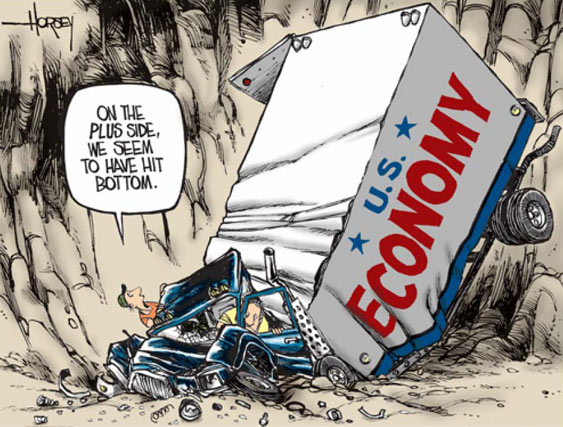
"I don't care if you're driving a hybrid or SUV. If you're driving toward a cliff, you have to change direction, that's what the American people called for."
- Barack Obama
"They're in a bus and they're driving for a cliff. And either we're going to drive off the edge of the cliff or we're going to turn course. If we continue on this current policy path, we are going over that cliff."
- Peter Schiff
 Wow, what can I say? I never thought I would make it this far and definitely not this fast. When I started this blog I wasn't sure how much and at what frequency I would post. It all started with an idea to keep myself in check financially and keep a running blog of my progress. As I started writing some post about some of my experiences with personal finance, it slowly started to evolve into how government interference can effect our finances. This got me researching about economics, and how this effects our lives, our money and our freedoms. It has now transformed into a study guide/diary for economics, personal finances and my beliefs.


 This week North Carolina kicks off its state tax free holiday as do may other states. Sales tax is some of the most important tax levied by states. This provides temporary sales tax for consumers for purchasing a array items from clothes, computers, and back to school items. Carolina's law reads:
G.S. 105-164.13C provides an exemption for certain items of tangible personal property sold between 12:01 A.M. on the first Friday in August and 11:59 P.M. the following Sunday. For 2009, the dates are Friday, August 7th through Sunday, August 9th. Clothing, footwear, and school supplies of $100 or less per item; school instructional materials of $300 or less per item; sports and recreation equipment of $50 or less per item, computers of $3,500 or less per item; and computer supplies of $250 or less per item will be exempt.So is a tax holiday really good thing for the state government or individuals? Here are some of the pros and cons.
Sales tax exemptions create administrative difficulties for state governments, and for the retailers who must collect the tax. For examples, exempting groceries requires a sheaf of government regulations to police the border between nontaxable groceries and taxable snack food. A temporary exemption for clothing (or for any other back-to-school item) requires retailers and tax administrators to wade through a similar quantity of red tape for an exemption that lasts only a few days. Last year's tax-free weekend cost the state(North Carolina)nearly $12 million in lost revenues.The benefits of sales tax holidays are not limited to state residents, but also extend to consumers visiting from other states. For states struggling with continuing budget deficits, sales tax holidays offer less “bang for the buck” than more targeted tax breaks.Retailers know that many consumers will shift their spending toward sales tax holidays to take advantage of the temporary tax exemption. Unscrupulous retailers can take advantage of this shift in consumer behavior by increasing their prices (or failing to reduce them by the full amount of the sales tax break) during the tax holiday.Perhaps most important for cash-strapped lawmakers, sales tax holidays are costly. Revenue lost through sales tax holidays will ultimately have to be made up somewhere else, either through painful spending cuts or increasing other taxes.
Helps out struggling families that need a boost during these hard economic times for purchasing items such as school supplies and other items of need. The National Retail Federation's annual report says parents will spend close to 8 percent less this year to get their children ready to return to school.The tax savings combined with all the sale prices that retailers typically offer during the weekend make the dollar go further.The benefit to cash-strapped shoppers outweighs any inconvenience to merchants and state and local administration work.
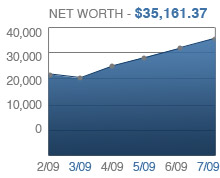
 Little over half the year and we are still rolling and still growing every month. It is such an amazing feeling to see my money growing in such a short period of time. Seems like we have a major purchase every month, and July was no different, we purchased a TV. I know that a TV isn't a need, but our main TV is broken and I need a TV before football season starts up(will save me money on not going to a bar, ha). On top of that, TV's are so cheap and we have the money for it. We have a lot of extra expenses coming up in August so I am not sure this month is going to be so kind to us as the past few. Lets break it down:
The one dollar bill is the most ubiquitous piece of paper in America. Collage asks the question: what might be done to make it something else? It is a ripe material: intaglio printed on sturdy linen stock, covered in decorative filigree, and steeped in symbolism and concept. Blade and glue transform it-reproducing the effects of tapestries, paints, engravings, mosaics, and computers-striving for something bizarre, beautiful, or unbelievable... the foreign in the familiar.


 From The Ayn Rand Institute
"Until and unless you discover that money is the root of all good, you ask for your own destruction. When money ceases to be the tool by which men deal with one another, then men become the tools of men. Blood, whips and guns -- or dollars. Take your choice -- there is no other -- and your time is running out."
* * *
"If we who were the movers, the providers, the benefactors of mankind, were willing to let the brand of evil be stamped upon us, and silently to bear punishment for our virtues -- what sort of ‘good' did we expect to triumph in the world?"
* * *
'Yes, this is an age of moral crisis. You are bearing punishment for your evil. But it is not man who is now on trial and it is not human nature that will now take the blame. It is your moral code that's through, this time. Your moral code has reached its climax, the blind alley at the end of its course. And if you wish to go on living, what you now need is not to return to morality . . . but to discover it."



"They let us vote on it, too, and everybody—almost everybody—voted for it, We didn't know. We thought it was good. No that's not true, either. We thought that we were supposed to think it was good. The plan was that everybody in the factory would work according to his ability, but would be paid according to his need.He goes on to explain how it worked
The Starnes heirs made long speeches about it, and it wasn't too clear, but no body asked any questions. None of knew how the plan would work, but every one of us thought the next fellow knew it. And if anybody had doubts, he felt guilty and kept his mouth shut—because they made it sound like anyone who'd oppose the plan was a child-killer at heart and less of a human being. They told us that this plan would achieve a noble idea.
"Try pouring water into a tank where there’s a pipe at the bottom draining it out faster than you pour it, and each bucket you bring breaks that pipe an inch wider, and the harder you work the more is demanded of you, and you stand slinging buckets forty hours a week, then forthy-eight, then fifty-six - for your neighbor’s supper - for his wife’s operation - for his child’s measles - for his mother’s wheel chair - for his uncle’s shirt - for his nephew’s schooling - for the baby next door - for the baby to be born - for anyone anywhere around you - it’s theirs to receive, from diapers to dentures - and yours to work, from sunup to sundown, month after month, year after year, with nothing to show for it but your sweat, with nothing in sight for you but their pleasure, for the whole of your life, without rest, without hope, without end … From each according to his ability, to each according to his need…"He goes on to explain how good men were forced to become bad
"We’re all one big family, they told us, we’re all in this together."
"It took us just one meeting to discover that we had become beggars - rotten, whining, sniveling beggars, all of us, because no man could claim his pay as his rightful earning, he had no rights and no earnings, his work didn’t belong to him, it belonged to ‘the family’, and they owed him nothing in return, and the only claim he had on them was his ‘need’ - so he had to beg in public for relief from his needs, like any lousy moocher, listing all his troubles and miseries, down to his patched drawers and his wife’s head colds, hoping that ‘the family’ would throw him the alms."
What was it they’d always told us about the vicious competition of the profit system, where men had to compete for who’d do a better job than his fellows? Vicious, wasn’t it? Well, they should have seen what it was like when we all had to compete with one another for who’d do the worst job possible. There’s no surer way to destroy a man than to force him into a spot where he has to aim at not doing his best, where he has to struggle to do a bad job, day after day. That will finish him quicker than drink or idleness or pulling stick-ups for a living.
“God help us, ma’am! Do you see what we saw? We saw that we’d been given a law to live by, a moral law, they called it, which punished those who observed it - for observing it. The more you tried to live up to it, the more you suffered; the more you cheated it, the bigger reward you got. Your honesty was like a tool left at the mercy of the next man’s dishonesty. The honest ones paid, the dishonest collected. The honest lost, the dishonest won. How long could men stay good under this sort of a law of goodness?
Was there any reason why this sort of horror would ever be preached by anybody? Was there anybody who got any profit from it? There was. The Starnes heirs. I hope you’re not going to remind me that they’d sacrificed a fortune and turned the factory over to us as a gift. We were fooled by that one, too. Yes, they gave up the factory. But profit, ma’am, depends on what it is that you’re after. And what the Starnes heirs were after, no money on earth could buy. Money is too clean and innocent for that.And the downfall..
Well, we got what we asked for. By the time we saw what it was that we’d asked for, it was too late. We were trapped, with no place to go. The best men among us left the factory in the first week of the plan. We lost our best engineers, superintendents, foremen and highest-skilled workers. A man of self-respect doesn’t turn into a milch cow for anybody. Some able fellows tried to stick it out, but they couldn’t take it for long. We kept losing our men, they kept escaping from the factory like from a pesthole - till we had nothing left except the men of need, but none of the men of ability.Pretty powerful writing and would take the time to not only read the book but read this part of the book. I know some might say it is extreme, but Health Care is not right it is a service. And to tax the wealthy to run/make deficit neutral is not right, I'm sorry it just isn't. Why are we forcibly taking someone’s income to the benefit of someone else?I have a problem with the concept of taking the fruits of someone’s hard earned labor simply so that I or someone else may benefit at their expense.
To work - on a blank check held by every creature born, by men whom you’ll never see, whose needs you’ll never know, whose ability or laziness or sloppiness or fraud you have no way to learn and no right to question - just to work and work and work - and leave it up to the Ivys and the Geralds of the world to decide whose stomach will consume the effort, the dreams and the days of your life. And this is the moral law to accept? This - a moral ideal?
Well, we tried it - and we learned. Our agony took four years, from our first meeting to our last, and it ended the only way it could end: in bankruptcy.
"Nobody spends somebody else's money as carefully as he spends his own. Nobody uses somebody else's resources as carefully as he uses his own. So if you want efficiency and effectiveness, if you want knowledge to be properly utilized, you have to do it through the means of private property."



 Posts
All Comments